


As an Amazon Associate, we earn from qualifying purchases.
Understanding the core differences of a pickleball vs tennis court layout is essential as paddle sports experience an unprecedented boom across North America. With local clubs facing a massive dilemma, there simply are not enough dedicated courts to keep up with player demand. If your local pickleball hubs are packed this weekend, you have probably stared at an empty tennis court and wondered: Can you play pickleball on a tennis court?
The short answer is yes, absolutely. However, stepping onto a tennis surface without understanding the structural differences can severely disrupt your game, your spacing, and your safety.
To help you seamlessly transition or set up temporary lines, our court maintenance and coaching staff put together this definitive pickleball vs tennis court guide. We will break down the exact dimensional footprints, net height modifications, and a step-by-step method to convert any standard tennis court into a pickleball paradise.
Quick Comparison: Pickleball vs Tennis Court Dimensions
Before diving into line tape and net straps, let's look at how a standard pickleball vs tennis court measures up side-by-side according to the official USA Pickleball rulebook and standard USTA doubles specs:
| Feature | Pickleball Court | Tennis Court (Doubles) |
|---|---|---|
| Total Minimum Footprint | 30 x 60 feet | 60 x 120 feet |
| Playable Inbound Area | 20 x 44 feet | 36 x 78 feet |
| Net Height (Center) | 34 inches | 36 inches |
| Net Height (At Posts) | 36 inches | 42 inches |
| Restricted Volley Zone | Yes (The Kitchen – 7 feet from net) | No (Players can volley anywhere) |
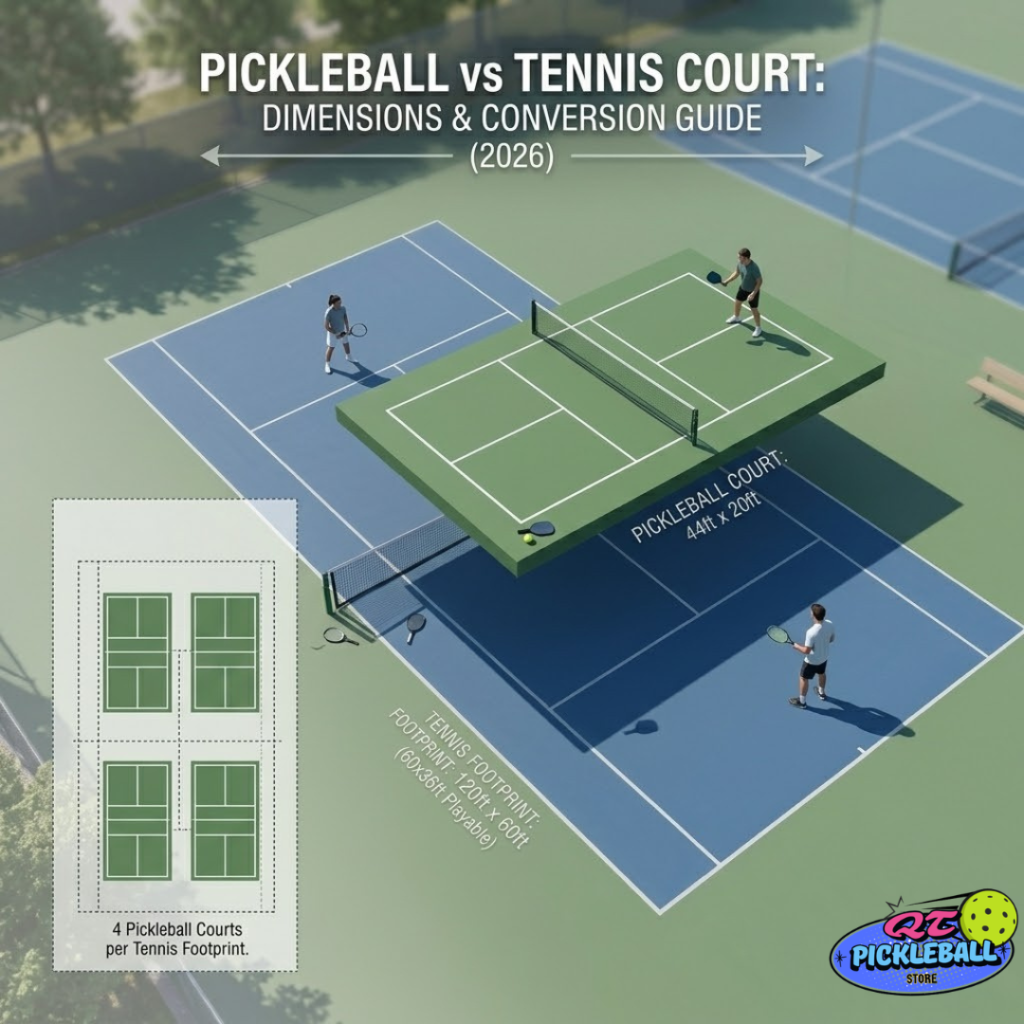
As the metrics show, a standard tennis court footprint is exactly twice as wide and twice as long as a pickleball court layout. This mathematical symmetry means you can comfortably fit four independent pickleball courts inside the total boundary fence of just one traditional tennis court.
(Looking for the raw numbers only? See our full [Pickleball Court Dimensions guide] for a dimension-only breakdown — this article focuses specifically on converting and playing on a shared tennis court.)
1. The Dimensional Breakdown: Understanding Court Spacing
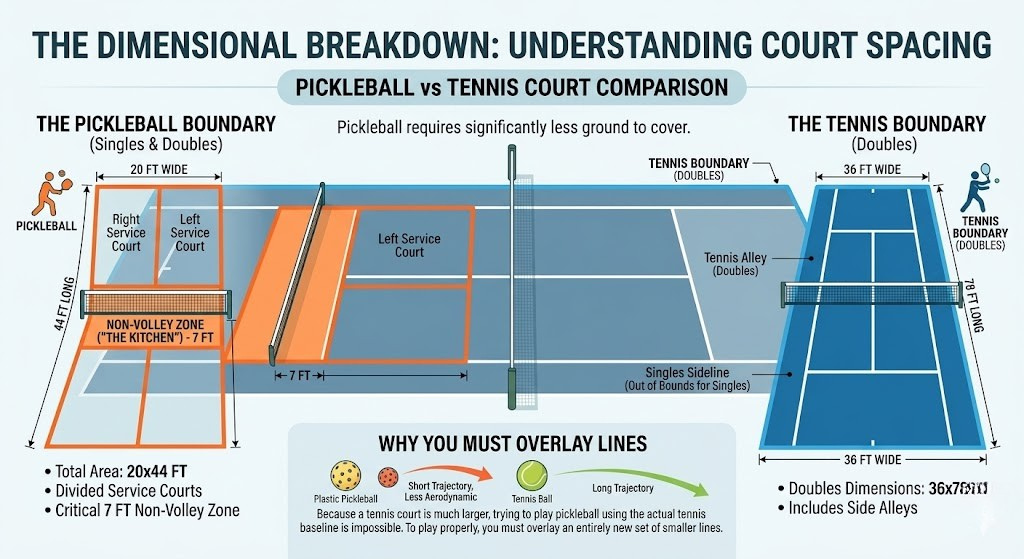
When evaluating a pickleball vs tennis court, the first thing you will notice is how much less ground you need to cover in pickleball.
The Pickleball Boundary
The total inbound boundary for a pickleball court is 20 feet wide by 44 feet long for both singles and doubles play. It is divided into right and left service courts, with a critical 7-foot dead zone extending from the net on both sides called the Non-Volley Zone (the “Kitchen”).
The Tennis Boundary
A standard doubles tennis court measures 36 feet wide by 78 feet long. It includes alleys on the sides that are active during doubles but considered out-of-bounds during singles matches.
Because a tennis court is significantly larger, trying to play a game of pickleball using the actual tennis baseline is impossible—the plastic ball simply does not possess the aerodynamic properties or bounce density to travel that far. To play properly, you must overlay an entirely new set of smaller lines.
2. The Net Dilemma: Height and Strap Adjustments
You cannot just run up to a tennis net and start dinking. The vertical differences between a pickleball vs tennis court net are substantial enough to ruin your baseline drives and soft drops.
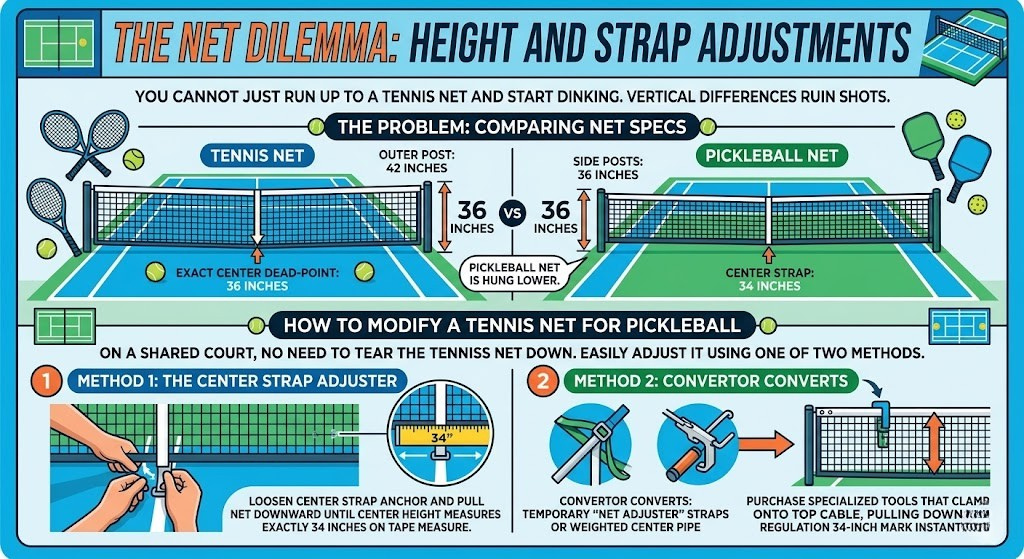
- Tennis Net Specs: A tennis net hangs at 42 inches at the outer posts and slopes down to 36 inches at the exact center dead-point.
- Pickleball Net Specs: A pickleball net is hung lower, measuring 36 inches at the side posts and dropping to 34 inches at the center strap.
How to Modify a Tennis Net for Pickleball
If you are playing on a shared court, you do not need to tear the tennis net down. You can easily adjust it using one of two methods:
- The Center Strap Adjuster: Loosen the center strap anchor on the tennis court floor and pull the net downward until the center height measures exactly 34 inches on a tape measure.
- Net Adjuster Straps: Purchase a set of temporary net adjuster straps or a weighted center pipe. These clamp onto the top cable of the tennis net, pulling it down to the regulation 34-inch mark instantly — no permanent modification needed.
Net Adjuster Strap
Portable Pickleball Net System
Prices and stock update on Amazon — click through for the current listing.
If you'd rather not touch the tennis net at all, a portable pickleball net system is the simplest fix — set it up anywhere inside the converted lines and skip the strap adjustment entirely.
3. How to Convert a Tennis Court for Pickleball (Step-by-Step)
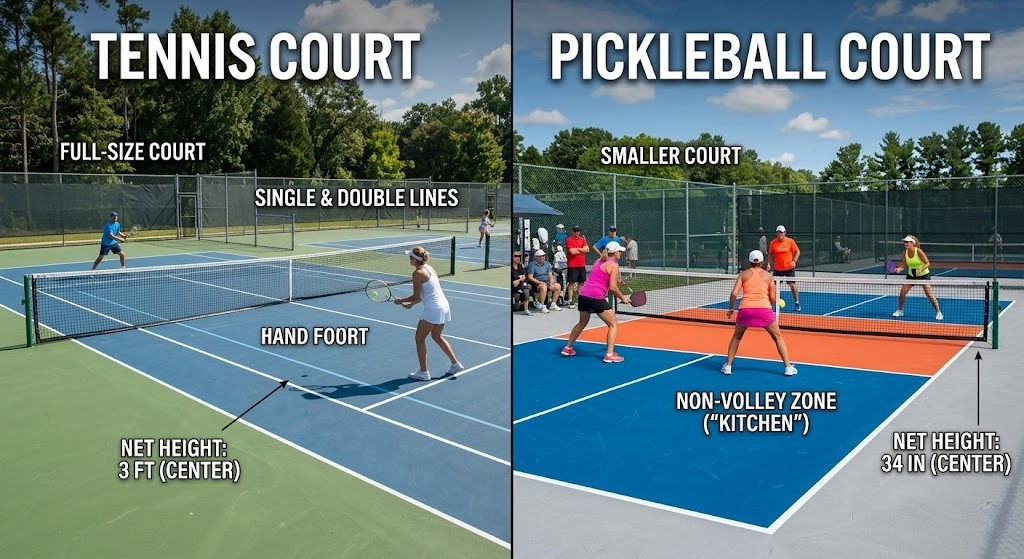
If you want to map out temporary lines on an existing tennis court surface, follow this court-tested protocol to ensure accurate dimensions without damaging the underlying acrylic coat:
Step 1: Gather the Right Materials
Do not use standard hardware duct tape or cheap plastic packing tape. These adhesives will bake under the sun and rip the expensive acrylic paint finish clean off the tennis court when removed. Instead, use:
- Yellow or Orange Contractor's Painter's Tape (FrogTape or Scotch Blue): Highly visible and peels away cleanly.
- Temporary Court Marker Lines: Heavy-duty, non-slip rubber strips that lay flat on the court without any adhesive.
Step 2: Establish the Center Point and Kitchen Line
Using the tennis net as your center axis, measure out exactly 7 feet from the net on both sides. Snap a chalk line or lay down your first strip of tape across the width of 20 feet. This marks the boundary of your Kitchen line.
Step 3: Outline the Baseline and Sidelines
From that 7-foot Kitchen line, measure back another 15 feet to establish your baseline (making the total distance from net to baseline 22 feet). Connect the corners with your 44-foot sidelines, ensuring the total width remains exactly 20 feet.
Step 4: Split the Service Boxes
Find the exact midpoint of your baseline (10 feet in) and run a center line straight from the baseline up to the Kitchen line. This cleanly creates your left and right service courts.
The Final Whistle: Adapting Your Gear to the Surface
Playing a temporary game of pickleball vs tennis court setups is an excellent way to get more court time, but keep in mind that tennis surfaces are highly abrasive. The grit texture designed to give heavy tennis balls their signature spin will wear down your gear rapidly.
Expert Performance Note: Because the ball bounces slightly lower on a converted tennis court compared to a dedicated slick concrete pickleball pad, using a highly forgiving paddle is essential. Our Franklin pickleball paddle guide covers a few beginner-friendly options with a composite fiberglass face or a plush 16mm core to help you generate effortless depth and pop, compensating for the slightly deadened bounce of converted tennis surfaces.
FAQ: Playing Pickleball on a Tennis Court
Can you play pickleball on a tennis court without any modifications?
Not accurately. The tennis court's boundary lines are too large for a real pickleball game, and the net hangs 2 inches too high at center. You need temporary tape lines and a lowered net for regulation play.
How many pickleball courts fit on one tennis court?
Four. A standard doubles tennis court is exactly double the width and double the length of a pickleball court, so its footprint holds four full pickleball courts side by side.
Will taping lines damage a tennis court?
Not if you use the right materials. Painter's tape (like FrogTape) or adhesive-free rubber court markers peel away cleanly. Standard duct tape or packing tape can strip the acrylic surface coating.
Do I need a separate net, or can I adjust the tennis net?
Either works. A net adjuster strap lowers a tennis net's center height to the regulation 34 inches in seconds. If you'd rather not touch the tennis net, a portable pickleball net system sets up independently on the converted lines.
Grab your tape, adjust that center strap down to 34 inches, lace up a sturdy pair of outdoor court shoes, and enjoy having twice as much room to play!
(Disclaimer: This article contains affiliate links, meaning we may earn a small commission if you purchase through our links at no additional cost to you.)
