


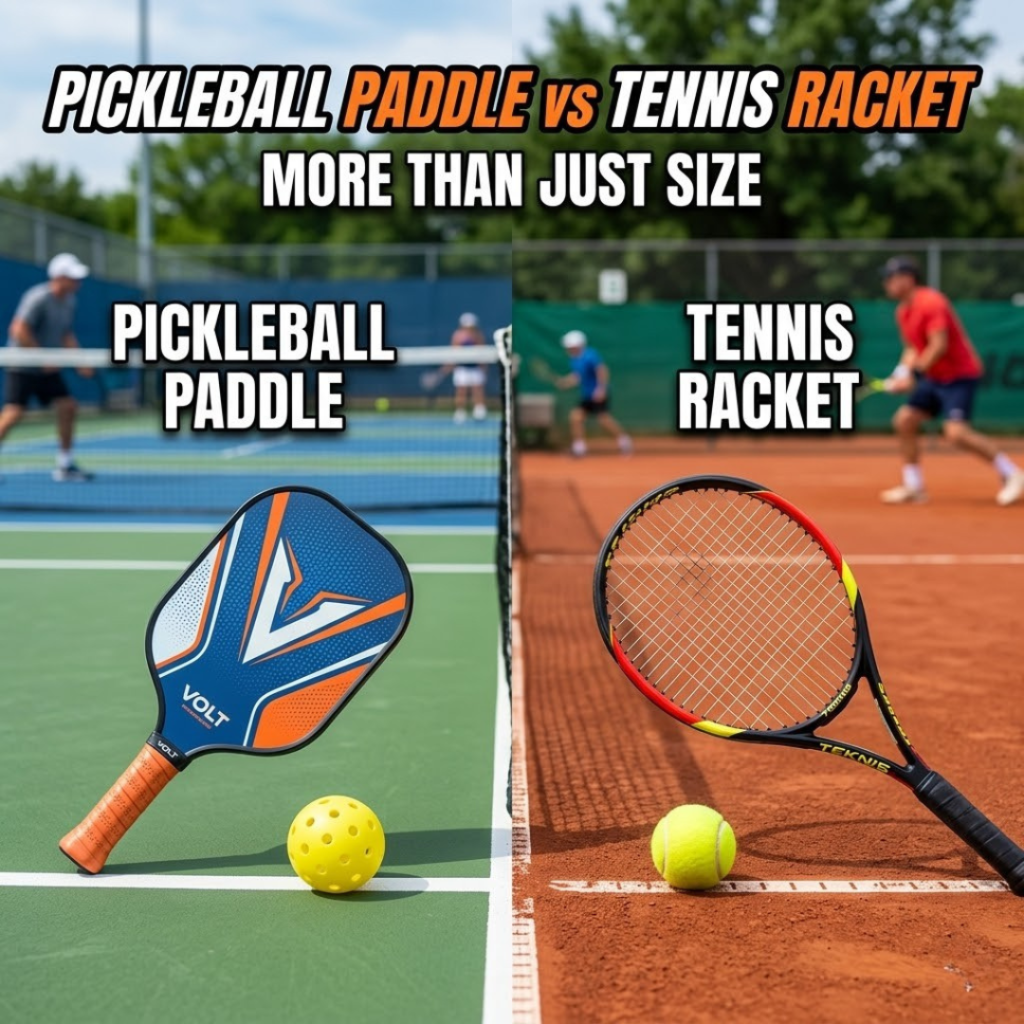
At first glance, all court sports look somewhat similar: you hold a tool in your hand, swing at a ball, and try to land it inside the boundary lines. However, if you are planning to transition from the tennis courts to the kitchen line this season, the very first thing you need to adapt to is your gear.
Stepping out with a pickleball paddle vs tennis racket reveals that these two instruments are built on completely opposite design philosophies.
While a tennis racket relies on the physics of high-tension strings and sweeping geometric frames, a modern pickleball paddle is a high-tech sandwich of aerospace cores and textured carbon surfaces. To ensure you understand exactly what you are holding during your next rally, here is our definitive breakdown of the core differences in materials, structural mechanics, and weight distribution.
Side-by-Side: Pickleball Paddle vs Tennis Racket
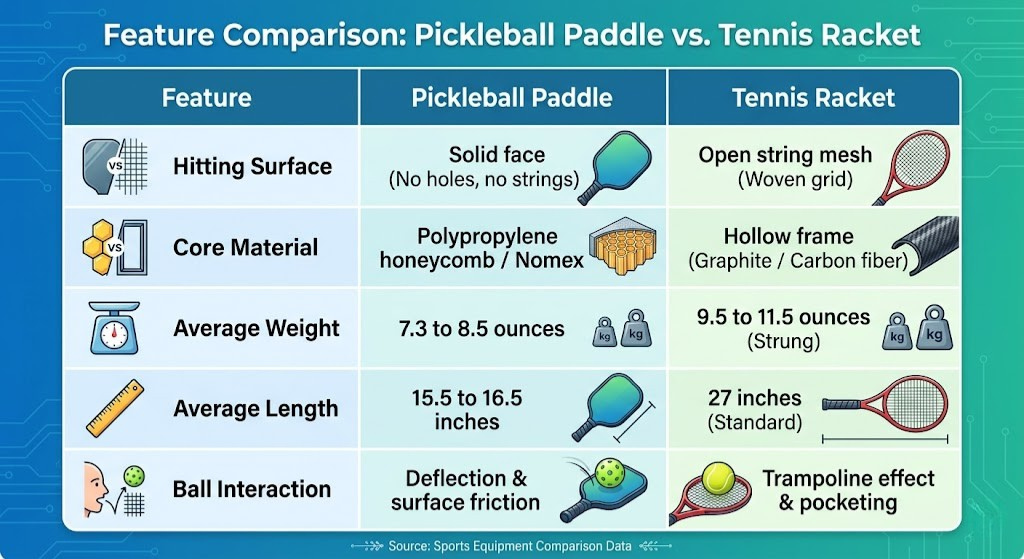
Before breaking down the engineering, let's look at the quick physical contrast between a standard adult tennis racket and a performance pickleball paddle:
| Feature | Pickleball Paddle | Tennis Racket |
|---|---|---|
| Hitting Surface | Solid face (No holes, no strings) | Open string mesh (Woven grid) |
| Core Material | Polypropylene honeycomb / Nomex | Hollow frame (Graphite / Carbon fiber) |
| Average Weight | 7.3 to 8.5 ounces | 9.5 to 11.5 ounces (Strung) |
| Average Length | 15.5 to 16.5 inches | 27 inches (Standard) |
| Ball Interaction | Deflection & surface friction | Trampoline effect & pocketing |
1. Material Evolution: What Are They Made Of?
The physical composition of today's racket and paddle technology looks closer to aerospace engineering than traditional sports manufacturing.
What is a Pickleball Paddle Made Of?
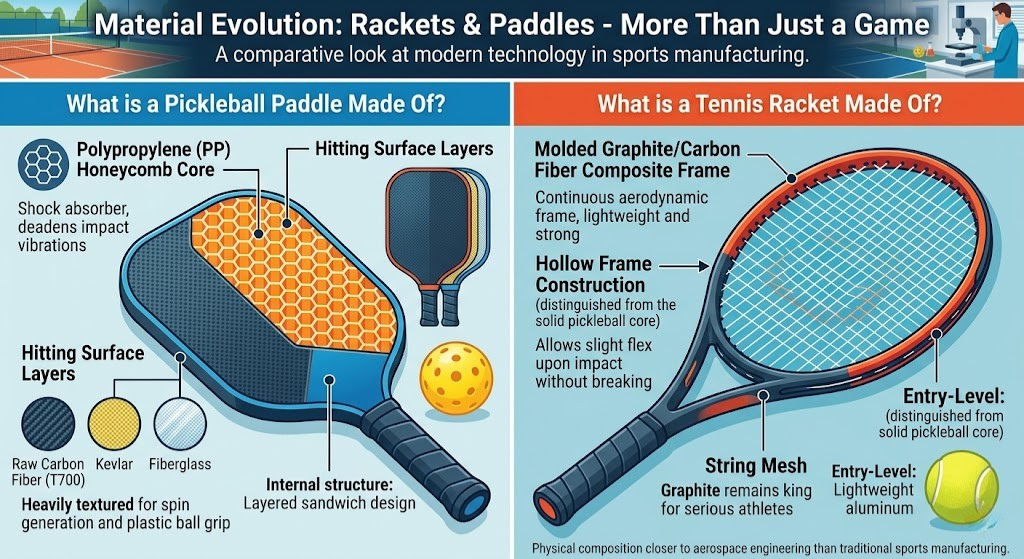
A modern pickleball paddle consists of an internal honeycomb core bonded between two flat face sheets. The absolute standard for performance is a Polypropylene (PP) honeycomb core, which acts as a shock absorber to deaden impact vibrations.
For the hitting surface, manufacturers utilize advanced sheets of Raw Carbon Fiber (T700), Kevlar, or Fiberglass. These faces are heavily textured to grip the plastic ball and generate heavy spin.
What is a Tennis Racket Made Of?
Unlike the layered sandwich structure of a paddle, a tennis racket is a hollow, continuous aerodynamic frame. High-end tennis rackets are molded from premium Graphite or Carbon Fiber composites, allowing the frame to flex slightly upon impact without breaking. Cheap entry-level rackets may use lightweight aluminum, but graphite remains the king of stability and control for serious athletes.
2. Structural Mechanics: Solid Face vs. String Mesh
The most dramatic variable When analyzing the structural mechanics of a pickleball paddle vs tennis racket, the most dramatic variable is how the hitting surface interacts with the ball.
The String Mesh Trampoline
A tennis racket features an open hoop woven with heavy-duty polyester, nylon, or natural gut strings under high tension (typically 48 to 60 lbs). When a tennis ball hits the racket, the strings stretch backward, “pocketing” the ball for a millisecond before snapping forward. This structural trampoline effect generates massive velocity and allows players to strike heavy baseline groundstrokes from 70 feet away.
The Solid Deflection Surface
Conversely, a pickleball paddle features a completely solid hitting surface with absolutely no strings or openings. When the lightweight, perforated plastic ball strikes the paddle, there is zero pocketing. The ball deflects instantly off the rigid face.
Instead of relying on string elasticity for spin, pickleball players rely on the microscopic friction and grit of the carbon fiber face to “bite” the plastic shell during short, tactical exchanges.
3. Weight and Swing Dynamics
The stark contrast in total weight between a pickleball paddle vs tennis racket fundamentally alters your swing mechanics and athletic stamina on the court.
- Tennis Weight Distribution: A standard strung tennis racket weighs between 9.5 and 11.5 ounces. Because it is significantly heavier and longer, swinging a tennis racket requires long, fluid, and looping strokes. You use your shoulder and core to drive through the ball, relying on momentum.
- Pickleball Weight Distribution: A standard paddle weighs between 7.3 and 8.5 ounces. It is much shorter, bringing the balance point closer to your hand. This lightweight profile enables lightning-fast hand speed, which is crucial during rapid-fire volley battles at the Kitchen line. You swing primarily with short, compact strokes rather than a massive tennis follow-through.
The Final Verdict: Choosing Your Weapon
Understanding the technological divide between a pickleball paddle vs tennis racket helps explain why you cannot simply apply raw tennis power to a pickleball match.
Expert Gear Advice: If you are a beginner looking for the perfect entry into the sport, don't just grab a cheap wooden paddle. Look for a proper beginner pickleball paddle featuring a 16mm polypropylene core and a carbon fiber face. This specific combination mimics some of the plush, shock-absorbing feel that tennis players are used to, giving you the ultimate control over your soft dinks and baseline drops.
Whether you prefer the high-velocity string physics of tennis or the quick-reflex tactical placement of pickleball, using the correct tool for the surface will protect your joints and elevate your game!
