
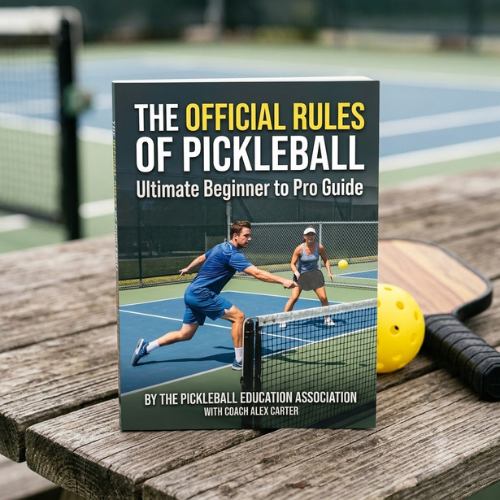
Pickleball has earned its reputation as the fastest-growing sport globally for a very specific reason: it is incredibly easy to pick up, yet deeply strategic to master. For those stepping onto the court for the first time, the unique combination of elements from tennis, badminton, and ping-pong can feel immediately familiar. However, as rallies speed up and games become highly competitive, relying on casual assumptions can lead to costly faults, lost points, and frustrating court arguments.
To build a flawless tactical game and play with total confidence, developing a rock-solid understanding of the official rules of pickleball is an absolute prerequisite. Whether you are setting up a temporary court in your driveway or entering your first local tournament bracket, this definitive guide breaks down the essential mechanics every athlete must memorize.
Essential Pickleball Rules for Beginners
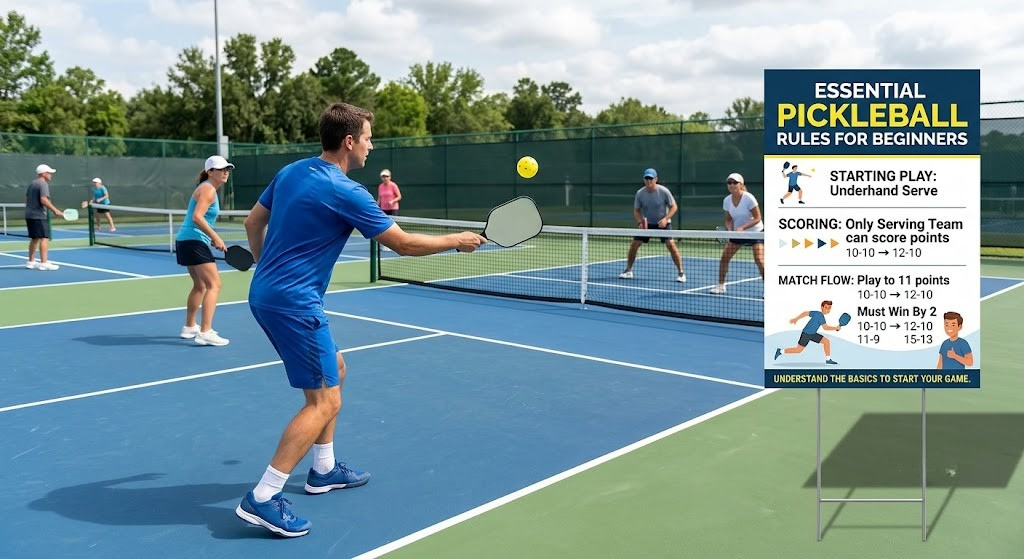
Before diving into complex kitchen scenarios or advanced spin mechanics, every player needs to understand how a standard match flows. Pickleball can be enjoyed in different formats, but the foundational mechanics remain identical across all courts. The game always begins with an underhand serve, and points can only be scored by the team currently serving.
A standard match is played to 11 points, and a team must win by a margin of 2 points. This means if the score ties at 10-10, play continues dynamically until one side establishes a clear two-point lead (such as 12-10 or 15-13). Understanding these baseline pickleball rules for beginners prevents early scoring confusion and sets the stage for formal competitive play.
Serving Mechanics and Tactical Transitions
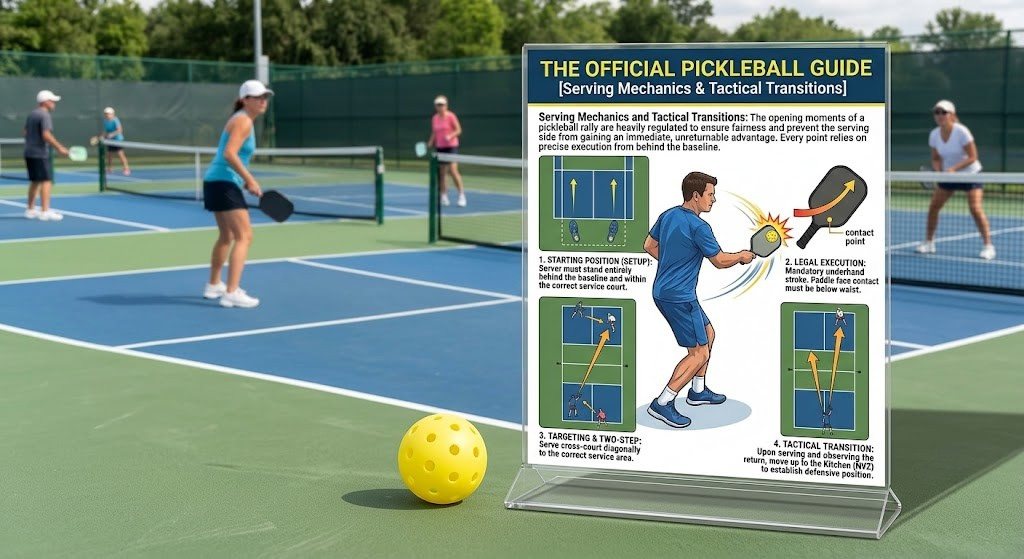
The opening moments of a pickleball rally are heavily regulated to ensure fairness and prevent the serving side from gaining an immediate, unreturnable advantage. Every point relies on precise execution from behind the baseline.
Official Serving Regulations
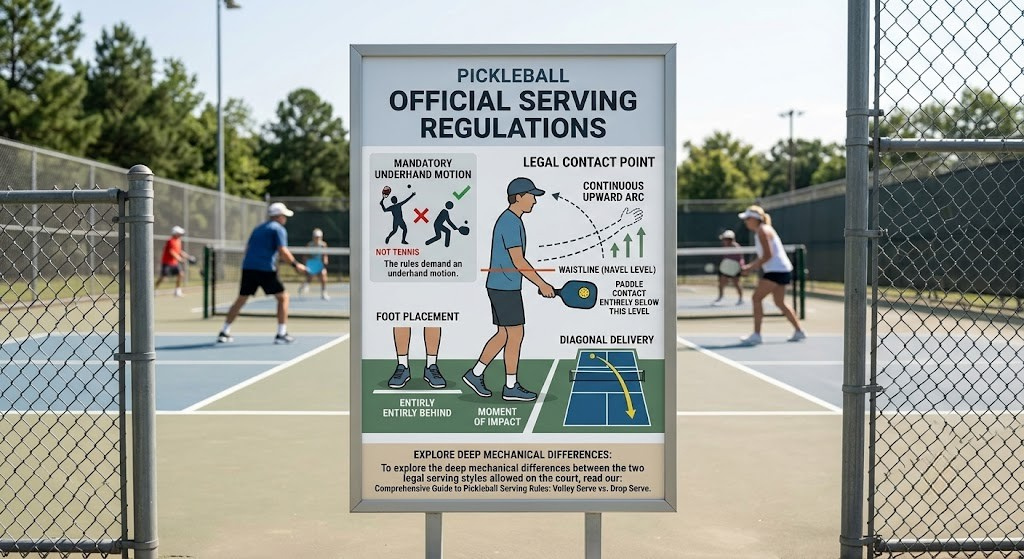
Unlike tennis, where overhand smashing dominates the serve, the rules of pickleball demand an underhand motion. The paddle contact with the ball must occur entirely below your waistline (specifically the navel level), and your arm must move in a continuous upward arc. Furthermore, both feet must remain behind the baseline at the moment of impact.
The ball must travel diagonally across the net and land cleanly within the boundaries of the opponent's diagonal service court. To explore the deep mechanical differences between the two legal serving styles allowed on the court, read our Comprehensive Guide to Pickleball Serving Rules: Volley Serve vs. Drop Serve.
The Strategic Two-Bounce Rule
Once the ball is successfully served across the net, players must navigate the most critical structural rule in the sport: the two-bounce requirement.
The Two-Bounce Rule Definition: The receiving team must let the served ball bounce once before returning it. Following that return, the serving team must also let the returned ball bounce once before playing it out of the air.
This rule eliminates the classic “serve-and-volley” dominance seen in tennis, forcing the serving team to stay back and allowing the receiving team to safely claim the net. To master the positional strategy required to survive this phase of the game, study our detailed breakdown on The Pickleball 2-Bounce Rule Explained: Master the Strategic Transition Zone.
Transition Training
To bridge the gap between executing a legal deep serve and establishing a rock-solid position at the net, advanced players utilize specific training games. If you want to build the muscle memory needed to drop the ball safely from the baseline into the non-volley zone, explore our training manual on How to Practice the Pickleball 7-11 Drill: Master Control and Deep Drives.
Understanding Formats and Scoring Systems
Keeping track of the score in pickleball can feel intimidating to newcomers because of the unique three-number sequence used during doubles play. However, once you understand the underlying logic, it becomes second nature.
Decoding the Numbers
In a standard doubles match, the score is called out as three distinct numbers: Our Score – Their Score – Server Number. The server number indicates whether the current player is the first or second partner allowed to serve for that rotation before a side-out occurs.
| Scoring Step | Component | Description | Example |
|---|---|---|---|
| First Number | Serving Team Score | The current total points accumulated by the side serving. | 6 |
| Second Number | Receiving Team Score | The current total points accumulated by the side defending. | 4 |
| Third Number | Server Number | Identifies if it is the first or second partner serving. | 1 (Called as 6-4-1) |
To avoid committing technical faults by serving from the wrong side of the court or calling the incorrect rotation sequence, check out our complete guide: Master the Pickleball Scoring Rules: How to Code the Numbers in Doubles and Singles.
Singles vs. Doubles Variations
While doubles play focuses heavily on positioning, hand-speed, and patient dinking, singles play transforms the sport into an intense cardiovascular challenge. In singles, there is no second partner, so the score consists of only two numbers (Your Score – Opponent Score), and your server position (Left or Right side) is dictated strictly by whether your current score is even or odd.
To adapt your footwork and structural positioning for solo play, read our strategic analysis on Official Pickleball Rules for Singles: Major Strategy Shifts from Doubles Play. Conversely, if you are looking to improve your team chemistry and understand who covers the middle of the court during team rotations, read our companion piece: Standard Pickleball Doubles Rules and Court Positioning for Beginners.
Court Boundaries and Equipment Compliance
A player can have perfect stroke mechanics, but if they do not respect the physical boundaries of the court or if their gear fails regulatory inspections, they will consistently lose points.
Mastering the Non-Volley Zone (The Kitchen)
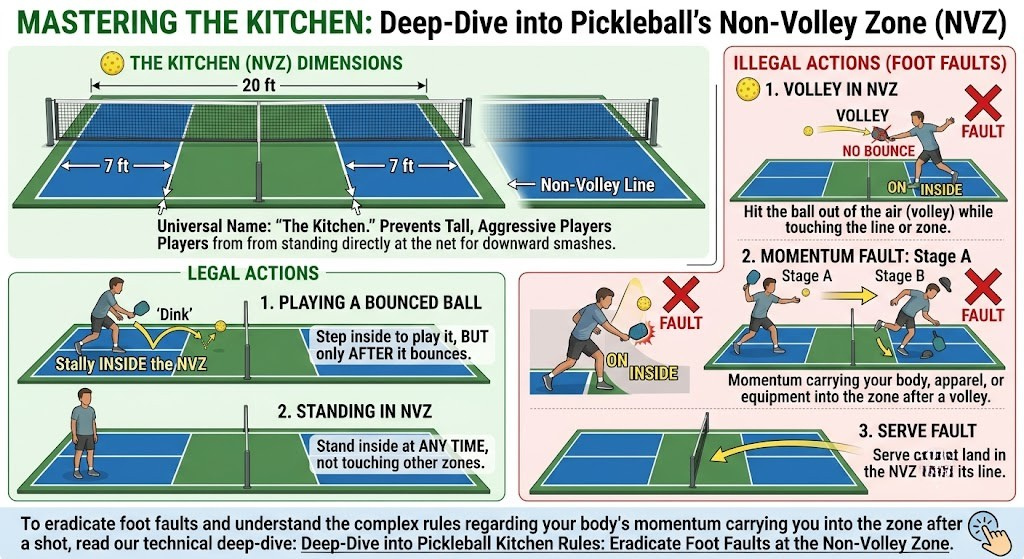
The 7-foot restricted zone extending symmetrically from the net on both sides is universally known as “The Kitchen.” The primary intent of this zone is to prevent tall, aggressive players from standing directly at the net and smashing every ball downward into the opponent's face.
You are legally allowed to stand inside the Kitchen at any time, but you cannot hit the ball out of the air (volley) while touching the Kitchen line or standing inside the zone. If the ball bounces inside the Kitchen, you may step inside to play it. To eradicate foot faults and understand the complex rules regarding your body's momentum carrying you into the zone after a shot, read our technical deep-dive: Deep-Dive into Pickleball Kitchen Rules: Eradicate Foot Faults at the Non-Volley Zone.
Court Blueprints and Layouts
A standard court surface measures 20 feet wide by 44 feet long for both singles and doubles play. The boundary lines are considered “in,” meaning if any portion of the ball kisses the outer edge of a line, it is ruled a live ball. The only exception is the Kitchen line during a serve, where hitting the line is considered a fault.
If you are planning to convert an old backyard layout or line a local park surface, check out our structural blueprint: Pickleball Court Dimensions: Complete Metric Blueprint for Tennis Court Conversions.
Equipment Certification and Regulations
As the sport evolves, equipment technology is progressing at an exponential rate. To maintain a fair playing field, USA Pickleball enforces strict guidelines regarding paddle materials, core thickness, and surface roughness.
📋 USA Pickleball Compliance Check
- 🔹 Surface Grit: Must not exceed strict friction limits.
- 🔹 Deflection Test: Core must not create a trampoline effect.
- 🔹 Certification Seal: Must prominently display “USA Pickleball Approved”.
Playing with an unapproved modification or a paddle that generates excessive surface grit can lead to immediate match disqualification. To ensure your current setup is fully compliant with updated tournament standards, read our safety review: What is a USA Pickleball Approved Paddle? Regulatory Equipment Standards.
Driving Conversions: Gear Alignment for Lawful Domination
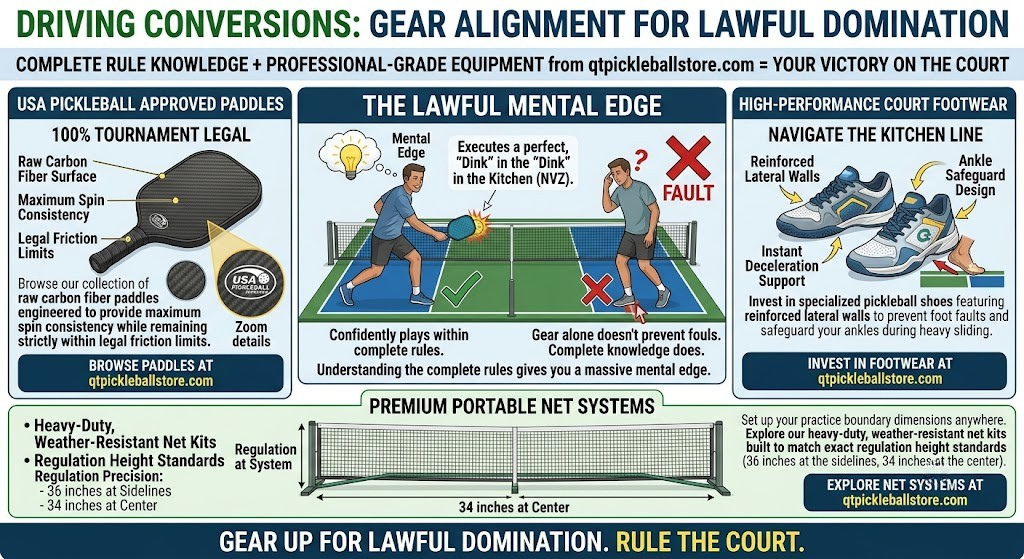
Understanding the complete rules of pickleball gives you a massive mental edge, but pairing that knowledge with professional-grade equipment from qtpickleballstore.com is what seals your victory on the court.
- USA Pickleball Approved Paddles: Ensure your equipment is 100% tournament legal. Browse our collection of raw carbon fiber paddles engineered to provide maximum spin consistency while remaining strictly within legal friction limits.
- High-Performance Court Footwear: Navigating the Kitchen line requires instant deceleration. Invest in specialized pickleball shoes featuring reinforced lateral walls to prevent foot faults and safeguard your ankles during heavy sliding.
- Premium Portable Net Systems: Set up your practice boundary dimensions anywhere. Explore our heavy-duty, weather-resistant net kits built to match exact regulation height standards (36 inches at the sidelines, 34 inches at the center).
Final Verdict on Rule Mastery
Memorizing the official boundaries, scoring sequences, and serving mechanics transforms your entire approach to the sport. By eliminating unforced errors and respecting the unique structural limitations of the Kitchen and the two-bounce rule, you shift your energy from guessing the laws to dominating the tactical flow of the rally.
Study the rules carefully, equip yourself with certified gear from qtpickleballstore.com, and step onto the court with absolute competitive confidence.
