
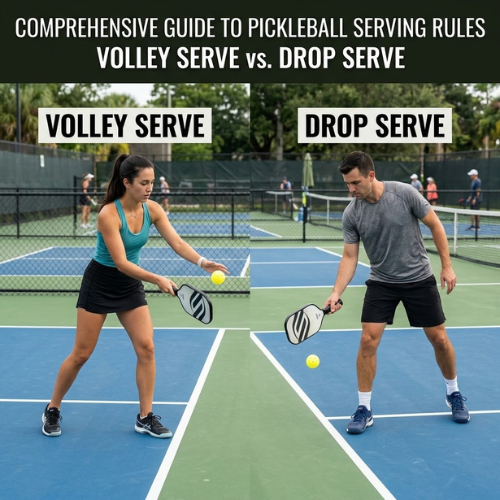
The serve is the only shot in pickleball where you have complete control over the game's initiation. While casual players often treat it as a mere formality to start a rally, high-level competitors view it as a tactical weapon designed to force a weak return. However, before you can master the spin and placement of your serve, you must ensure your execution complies with the official pickleball serving rules.
Whether you are preparing for your first local tournament or simply looking to level up your consistency, understanding the mechanics of legal serves is essential. If you are new to the sport and need a refresher on the total regulatory framework of the game, be sure to reference our Official Rules of Pickleball: Ultimate Beginner to Pro Guide.
The Two Legal Pickleball Serving Styles
According to the USA Pickleball rulebook, players have two distinct, legal ways to put the ball into play. Each method has its own mechanical requirements.
1. The Volley Serve (The Traditional Method)
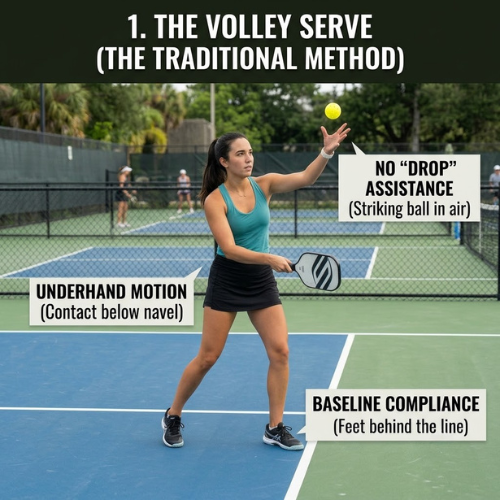
The volley serve is the most common method. The player strikes the ball in the air without letting it bounce on the court first. To keep this serve legal and consistent with pickleball rules serving standards, you must adhere to these three requirements:
- Underhand Motion: The arm must move in an upward arc, and the paddle contact must be made below your waist (specifically, the navel level).
- Baseline Compliance: Both feet must remain behind the baseline and inside the imaginary extension of the sidelines at the moment of impact.
- No “Drop” Assistance: You cannot bounce the ball on the court to assist your volley serve.
2. The Drop Serve (The Modern Alternative)
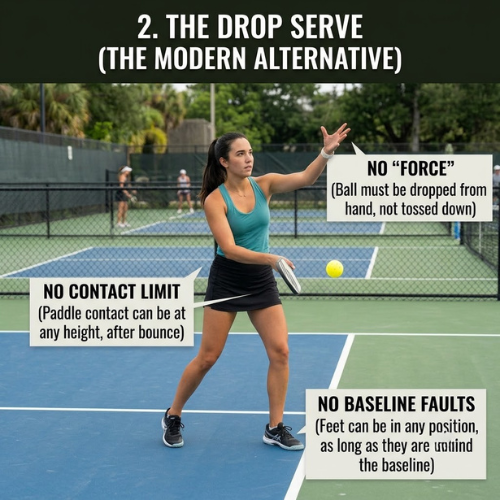
Introduced to simplify the rules and lower the barrier to entry, the drop serve allows players to bounce the ball on the court before hitting it. This method has fewer mechanical restrictions:
- No Contact Limit: You are not restricted by the “waist-high” contact rule. You can strike the ball at any height—above or below your waist—after it bounces.
- No “Force”: You cannot “toss” the ball downward to create an unnatural bounce. It must be dropped or released from your hand.
- No Baseline Faults: Since you are dropping the ball within the court, your feet can be in any position, as long as they are behind the baseline.
Critical Service Faults to Avoid
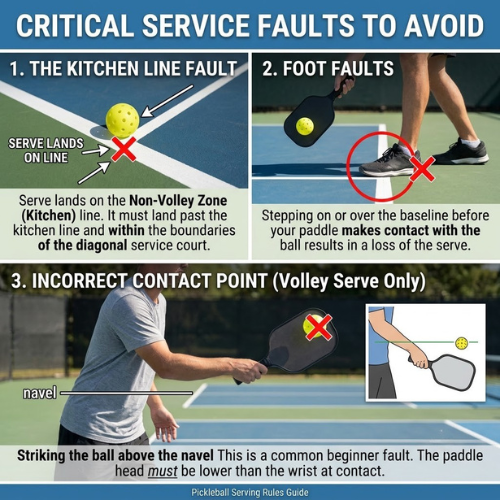
Even if your technique looks perfect, you could be committing a service fault without realizing it. Based on the pickleball serving rules, here are the most common pitfalls:
- The Kitchen Line Fault: If your serve lands on the Non-Volley Zone (Kitchen) line, it is an immediate fault. The serve must land past the kitchen line and within the boundaries of the diagonal service court.
- Foot Faults: Stepping on or over the baseline before your paddle makes contact with the ball results in a loss of the serve.
- Incorrect Contact Point (Volley Serve Only): Striking the ball above the navel is the most frequent fault for beginners. Ensure your paddle head is lower than your wrist at contact.
To understand how these faults interact with the broader game flow, such as the two-bounce rule, read our deep-dive analysis on The Pickleball 2-Bounce Rule Explained: Master the Strategic Transition Zone.
Equipment Matters: Enhancing Your Serve with Raw Carbon Fiber
In the modern era of pickleball, where players are utilizing aggressive topspin to keep opponents pinned at the baseline, your paddle selection is just as important as your technique.
To maximize the RPMs (revolutions per minute) on your serve, you need a paddle that “grabs” the ball upon contact. We highly recommend players upgrade to Raw Carbon Fiber paddles. Unlike composite or plastic surfaces, the textured, grit-infused surface of raw carbon fiber provides:
- Superior Ball Bite: The microscopic texture grips the ball longer, allowing you to generate massive spin on your serve without changing your swing speed.
- Increased Consistency: A consistent surface texture means your serve will react predictably every time, helping you avoid those unforced errors.
- Better Control: For those utilizing the Drop Serve, carbon fiber paddles offer the “dwell time” needed to place the ball deep in the opponent's corner.
Ready to upgrade your gear? Browse our curated collection of USA Pickleball Approved Paddles that feature advanced raw carbon fiber surfaces designed for maximum spin potential.
Mastering the Serve: Final Thoughts
Mastering the pickleball serving rules is the first step toward competitive dominance. By understanding the mechanical differences between the Volley and Drop serve, avoiding common faults, and equipping yourself with high-spin carbon fiber technology, you turn your serve into an offensive tool rather than a liability.
- Practice Tip: Spend 15 minutes every session focusing purely on the depth of your serve. Aim for the last two feet of the court.
- Gear Check: Ensure your paddle is tournament-ready. If you are unsure if your current gear is legal, read our equipment standard breakdown: What is a USA Pickleball Approved Paddle? Regulatory Equipment Standards.

Pingback: Official Pickleball Rules Singles: Master 1v1 Strategy & Gear - QT Pickleball Store
Pingback: Pickleball Court Dimensions: Complete Metric Blueprint for Tennis Court Conversions - QT Pickleball Store