


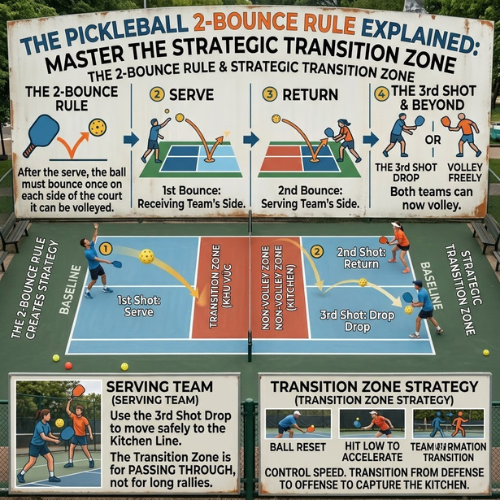
For tennis players or generic racket sport enthusiasts stepping onto a pickleball court for the first time, the game can initially feel like a miniature version of what they already know. You grab a paddle, line up behind the baseline, and prepare to trade rapid volleys. However, within the first two hits of a formal rally, newcomers almost always commit an immediate, baffling fault. They hit the ball cleanly out of the air, only to hear the opponent call a stoppage.
The culprit? A fundamental misunderstanding of the pickleball 2 bounce rule.
This single mechanical restriction is arguably the most important element in the entire rulebook. It fundamentally dictates court positioning, rally length, and the overall tactical rhythm of the sport. If you are currently studying what are the rules of pickleball to transition from a backyard recreational player to a disciplined tournament competitor, mastering this rule—and learning how to survive the tactical dilemmas it creates—is your absolute first priority.
Before diving into the advanced positioning strategies shaped by this rule, make sure you have a firm grasp of the complete foundational framework by reading our cornerstone manual: The Official Rules of Pickleball: Ultimate Beginner to Pro Guide.
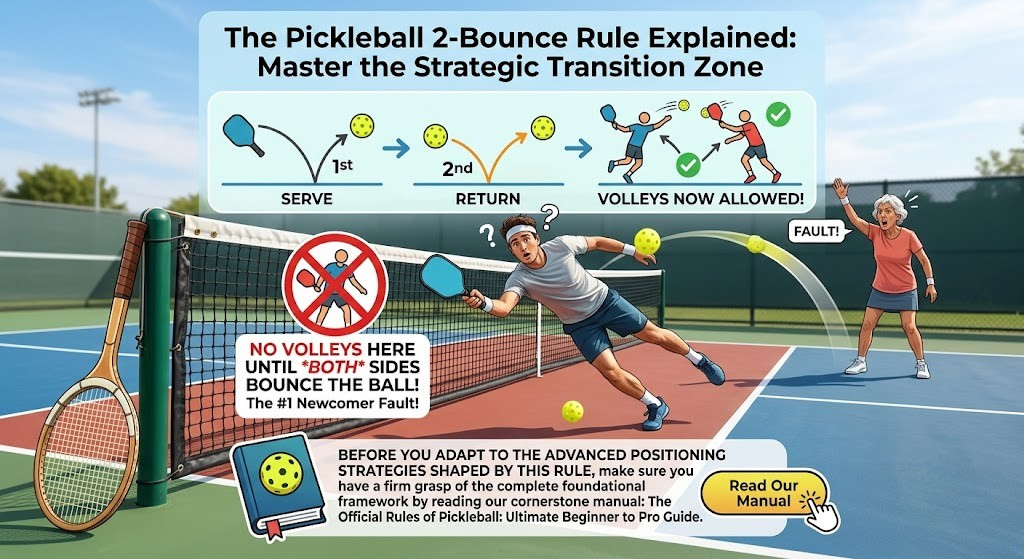
What Exactly is the Pickleball 2-Bounce Rule?
The core mechanic of this rule is straightforward, but it requires strict mental discipline during fast-paced exchanges.
The Official Definition: When the ball is served, the receiving team must allow the ball to bounce once before returning it. Following that return, the serving team must also allow the incoming ball to bounce once before striking it.
To visualize this sequence clearly during a point, break the opening exchange down into three mandatory phases:
⏱️ The 2-Bounce Rule Sequence
The mandatory opening sequence required before players can volley out of the air.
Phase 1
Phase 2
Phase 3
Once these two initial bounces have occurred safely on each side of the net, the restriction expires completely. For the remainder of the rally, both teams are legally permitted to either volley the ball out of the air or play it off a standard bounce.
If any player on either team violates this sequence by hitting a volley before the second bounce has concluded, an immediate mechanical fault is triggered, and the opposing side is awarded the point or side-out.
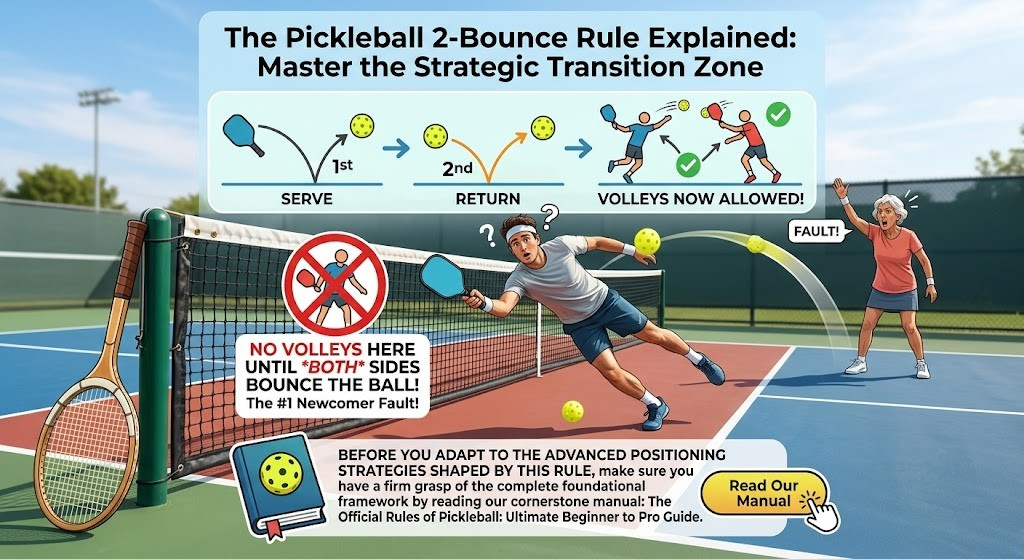
Why the Two-Bounce Rule Exists: Preventing Net Dominance
To truly appreciate this rule, you have to understand the architectural intent behind its creation. In traditional tennis, the “serve-and-volley” strategy is incredibly dominant. A powerful server can smash a high-velocity ball and immediately sprint straight to the net, using their physical height and arm span to smash down any weak returns before the opponent can set up a defensive position.
If pickleball allowed immediate serving volleys, the game would be broken. Because a pickleball court is only 44 feet long, a serving player could serve and reach the net in a single step. Rallies would last an average of two hits, completely eliminating the soft, chess-like dinking strategy that defines the sport.
The pickleball 2 bounce rule acts as a brilliant equalizer. By forcing the serving team to stay back behind the baseline to wait for the return bounce, the rule guarantees a neutral opening sequence. It gives the receiving team an intentional tactical advantage: since they do not have to wait for a second bounce on their side, the player returning the serve can strike the ball and immediately rush forward to claim the non-volley zone line (the Kitchen).
The Strategic Nightmare: The Transition Zone
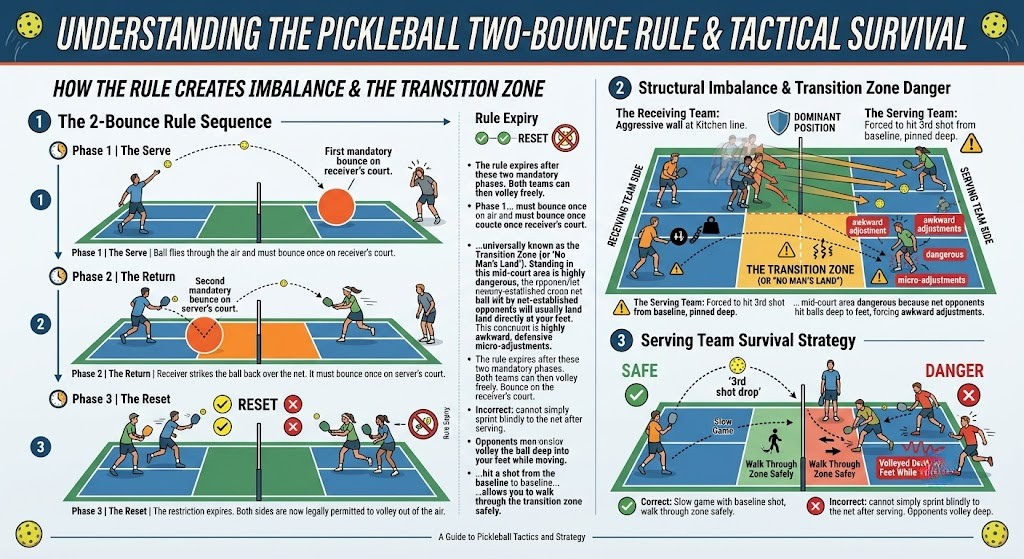
Because of the two-bounce requirement, every pickleball point begins with a structural imbalance:
- The Receiving Team: Quickly establishes a dominant, aggressive wall directly at the Kitchen line.
- The Serving Team: Is pinned deep behind the baseline, forced to hit their 3rd shot from the back of the court.
The massive space between the baseline and the Kitchen line is universally known as the Transition Zone (or “No Man's Land”). Standing in this mid-court area is highly dangerous because a ball hit by the net-established opponents will usually land directly at your feet, forcing you into highly awkward, defensive micro-adjustments.
⏱️ The 2-Bounce Rule Sequence
The rule expires after these two mandatory phases. Both teams can then volley freely.
Phase 1
Phase 2
Phase 3
As the serving team, you cannot simply sprint blindly to the net after your serve, or your opponents will volley the ball deep into your feet while you are still moving. You must hit a shot from the baseline that slows down the game and allows you to walk through the transition zone safely.
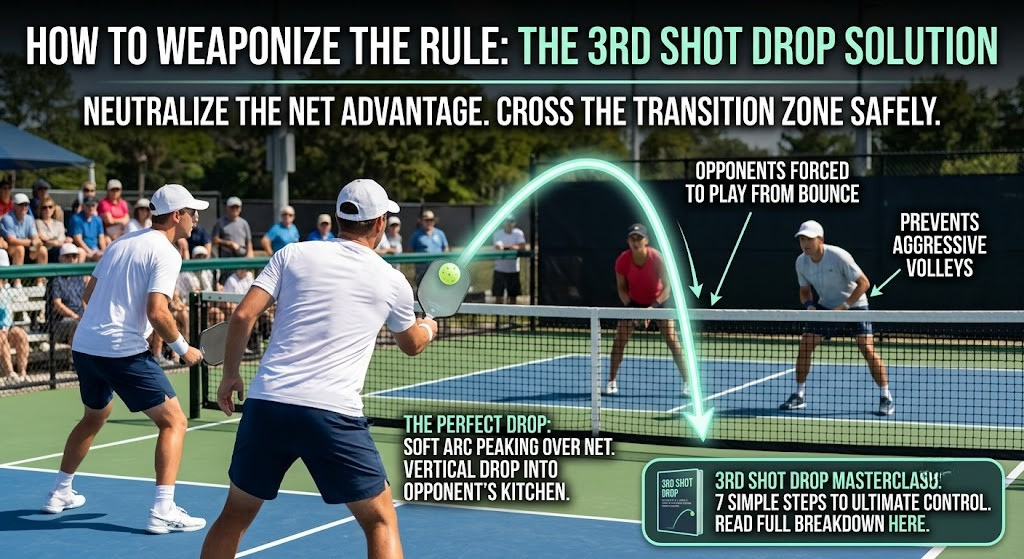
How to Weaponize the Rule: The 3rd Shot Drop Solution
This brings us to the ultimate tactical question in modern pickleball: How does the serving team successfully neutralize the opponent's net advantage and cross the transition zone safely?
The definitive answer is the cornerstone of advanced strategy: the 3rd Shot Drop.
Instead of hitting a hard, driving ball that your opponents can easily block downward out of the air, you must execute a soft, unattackable arc that peaks over the net and drops vertically into the opponent's Kitchen. A perfect drop forces your opponents to hit the ball off a bounce, preventing them from driving it aggressively and giving you and your partner the crucial seconds needed to sprint forward and equalize the positioning at the net.
To transform this defensive dilemma into your primary point-winning weapon, follow our complete technical breakdown: 3rd Shot Drop Masterclass: 7 Simple Steps to Ultimate Control.
Common Mistakes and How to Prevent Them
Even intermediate athletes frequently commit unforced errors due to poor physical discipline regarding this rule. Keep these defensive adjustments in mind during your next practice session:
- Rushing Forward Too Fast as the Server: Many players hit a deep serve and immediately start drifting forward into the transition zone out of habit. If the return of serve lands deep near the baseline, they are caught moving forward and cannot adjust to the bounce. The Fix: Stay anchored one foot behind the baseline until you have physically struck your 3rd shot.
- Volleying the Return of Serve: When the opponent hits a soft, floating return of serve, it is incredibly tempting for the server to step inside the court and volley it out of the air. Remember, the second bounce must happen on your side. The Fix: Watch the ball make physical contact with the court surface before initiating your upward swing.
- Using the Wrong Equipment for the Soft Game: Trying to survive the transition zone with a stiff, ultra-powerful paddle often causes your drop shots to fly too deep, giving your opponents easy smashes. Utilizing a control-oriented paddle provides the “dwell time” needed to cushion heavy drives.
Final Thoughts on the Transition Zone
The pickleball 2 bounce rule is not just an arbitrary limitation; it is the tactical engine that defines the entire character of the sport. By understanding why the rule exists, respecting the positional advantage it gives to the receivers, and mastering the soft game required to cross the transition zone, you eliminate frustrating unforced errors and gain total control over the pace of the match.
Lace up your court shoes, focus on your baseline patience, and ensure your tactical execution is backed by certified gear from qtpickleballstore.com.
