
Some links in this guide are affiliate links. As an Amazon Associate, we earn from qualifying purchases at no extra cost to you. It never changes which paddles we recommend.
Showing up to a sanctioned tournament with the wrong paddle is a quiet kind of heartbreak. You have trained for months, you have the dinks and the drops, and then an equipment check ends your day before the first serve. It happens more often than you would think, because paddle technology now moves faster than most players' understanding of the rules.
USA Pickleball approved paddles are simply paddles that have passed independent laboratory testing against a published set of physical limits. This guide explains what those limits actually are in 2026, what changed recently and why it emptied some players' paddle bags, and which certified paddles are worth buying at every budget.
What USA Pickleball Approval Actually Means
USA Pickleball is the national governing body for the sport in the United States. It does not manufacture anything and it does not endorse brands. What it does is publish a set of measurable equipment standards and maintain a list of paddles that have been tested against them by independent laboratories.
A paddle earns its place on that list one model at a time. Approval belongs to a specific model and a specific production configuration, which is why a manufacturer that changes a paddle's face or core has to submit it again.

Why Certification Matters
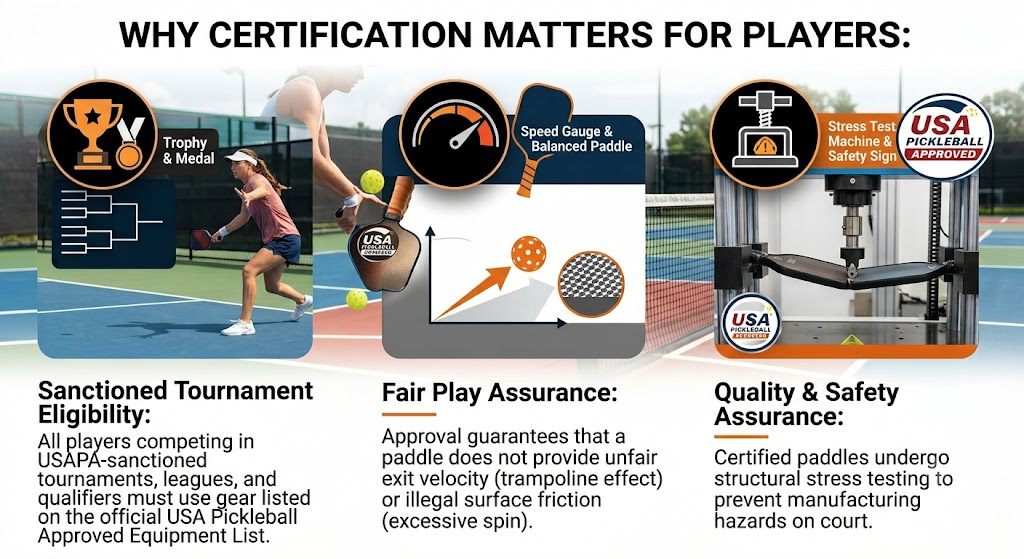
- Tournament eligibility. Every player in a USA Pickleball sanctioned tournament, league or qualifier must use equipment from the official approved list. Recreational play at your local courts has no such requirement.
- A level playing field. The standards exist to cap two things that separate a paddle from a weapon: how fast the ball comes off the face, and how much spin the surface can generate.
- Structural safety. Certified paddles are stress tested, which matters more than it sounds when a paddle is swung at speed a few feet from someone's face.
The Technical Standards a Paddle Must Meet
These are the published limits from the USA Pickleball Equipment Standards Manual. They are worth knowing precisely, because most of what circulates online about them is close but wrong.
| Parameter | Limit | What it prevents |
|---|---|---|
| Maximum length | 17 inches (43.18 cm) | Excessive reach and swing leverage |
| Combined length + width | 24 inches (60.96 cm) | Oversized defensive paddle faces |
| Thickness | No restriction | Nothing — 14mm and 16mm are equally legal |
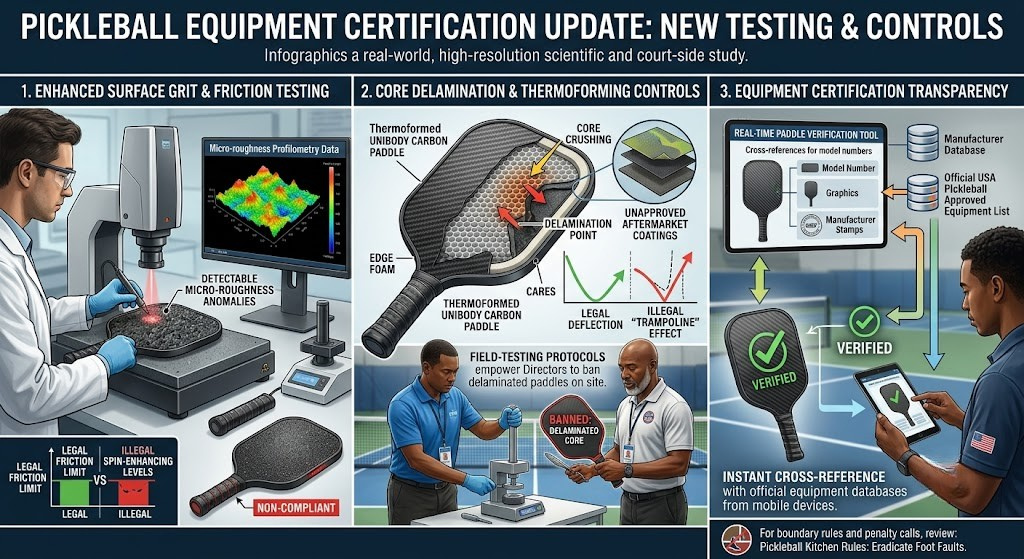
| Surface roughness (Rz) | 30 µm average, no single reading above 33 µm | Artificial spin from an abrasive face |
| Surface roughness (Rt) | 40 µm average, no single reading above 44 µm | Peaks that grip the ball beyond the intended range |
| Gloss | 80 GU maximum, measured at 60 degrees | Reflective faces that blind an opponent |
| PBCoR | 0.43 since 1 November 2025 | Trampoline effect and dangerous ball speed |
Two details in that table catch most players out.
The first is thickness. There is no thickness limit at all. The endless 14mm versus 16mm debate is a question of feel and playing style, never of legality, and any shop implying otherwise is guessing.
The second is how roughness is measured. USA Pickleball uses a Starrett SR160 or SR300 surface roughness tester and reads two values, Rz and Rt. It does not use Ra, the parameter most commonly quoted in paddle marketing. If a listing tells you its face is legal because of an Ra figure, that number has nothing to do with the actual test.
PBCoR: The Rule That Reshaped the Paddle Market
If you only remember one number from this guide, remember 0.43.
PBCoR measures how much energy a paddle returns to the ball. A higher figure means a livelier face and a ball that leaves faster for the same swing. USA Pickleball capped it at 0.44 on 1 November 2024, then tightened it to 0.43 on 1 November 2025, where it stands today.
That single decimal point mattered enormously. Several paddles that were legal in one season were no longer legal in the next, and a number of well-known power models had to be re-engineered or dropped. If you bought a paddle before late 2025 and have not checked it against the current list, check it now rather than at the registration desk.
Delamination: When a Legal Paddle Turns Illegal
Thermoformed paddles — unibody carbon construction with foam-injected walls — produce genuine power, and they introduced a genuine problem. Over months of play the bond between the face and the core can begin to separate, or the core cells can crush. The paddle keeps its shape and its logo, but the face starts behaving like a trampoline, and its real-world PBCoR climbs past the paddle it was when it left the factory.
This is why the sport now takes on-site testing seriously. Tournament directors are able to test suspect paddles at the venue and remove them from play, regardless of whether the model appears on the approved list. Approval describes a paddle in factory condition, not a paddle after eighteen months of hard hitting.
Two practical habits protect you. Listen to your paddle: a healthy face gives a crisp, consistent sound, while a delaminating one develops a hollow, rattling note that other players usually notice before you do. And press your thumb firmly across the face near the edges, feeling for soft or spongy patches that were not there when the paddle was new.
Top USA Pickleball Approved Paddles Worth Buying in 2026
Certification tells you a paddle is legal. It tells you nothing about whether it suits your game. These are certified options grouped by the kind of player they actually serve.
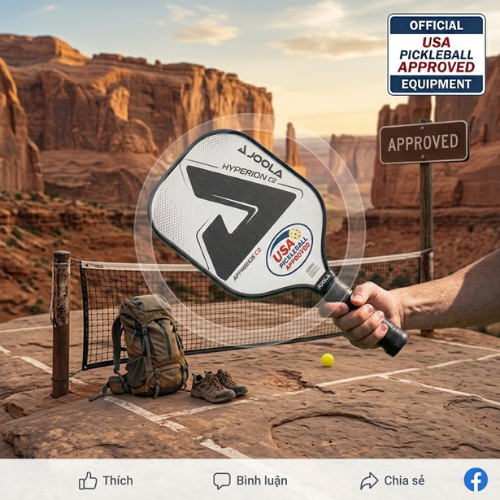
JOOLA — Perseus and Hyperion
JOOLA has spent several years at the front of professional pickleball, and its paddles are built for players who win points by taking time away from opponents. Charged Carbon Surface technology paired with a polymer honeycomb core produces real put-away power while staying inside the current PBCoR ceiling.
The Perseus rewards an aggressive game — fast hands at the kitchen line, heavy topspin drives, and the confidence to end rallies early. The Hyperion sits slightly closer to all-court balance.
Best for: aggressive players who play in front of the baseline and want power that stays legal.
Selkirk Sport — Vanguard Control and LUXX Control
Selkirk builds paddles for players who win by placement rather than pace. Florek carbon fiber faces and QuadFlex honeycomb cores give a soft, predictable touch that makes third-shot drops and resets more repeatable, and the surface texture is engineered to sit comfortably within the roughness limits rather than flirt with them.
Best for: control-first players, precise dinkers, and anyone whose game depends on the soft reset under pressure.
Vatic Pro — Prism Flash and Alchemy
Vatic Pro earned its reputation by delivering raw carbon thermoformed construction at a price that undercut the premium brands by a wide margin. The Prism Flash uses foam-injected walls for edge-to-edge stability, which keeps off-centre shots more usable than the paddle's price suggests.
Best for: intermediate and advanced players who want thermoformed performance without a flagship price tag.
Budget USA Pickleball Approved Paddles for New Players
Here is something the paddle industry would rather you did not dwell on: you do not need to spend premium money to play legally. Certification is a pass or fail test against published limits, and an inexpensive paddle that passes is exactly as tournament legal as a flagship that passes. What you give up at the lower price is refinement — feel, consistency, durability — not eligibility.
If you are buying your first paddle, or kitting out a family that has just discovered the sport, these certified sets do the job honestly.
JoncAye BLITZ Set — a four-paddle set with balls, a bag and overgrips. The most sensible starting point for a group learning together, at eight ounces with a large, forgiving sweet spot.
MTEN Paddle Set — a widebody fiberglass paddle that puts the sweet spot where beginners actually make contact. If your problem is mishits rather than power, this shape helps more than any material upgrade.
Panel Sound 14mm Set — a control-leaning option with a 14mm polypropylene honeycomb core, for players who would rather learn placement first and add pace later. A defensible way to build good habits.
JP WinLook Graphite Set — at 7.25 ounces this is the lightest of the group, which makes it worth a look for players coming from tennis, anyone with wrist or elbow concerns, and juniors.
One caveat worth stating plainly: paddle listings change their configurations more often than their titles suggest. Before a sanctioned event, confirm the exact model you own against the official database rather than trusting the product page.
How to Verify Your Paddle Before a Tournament
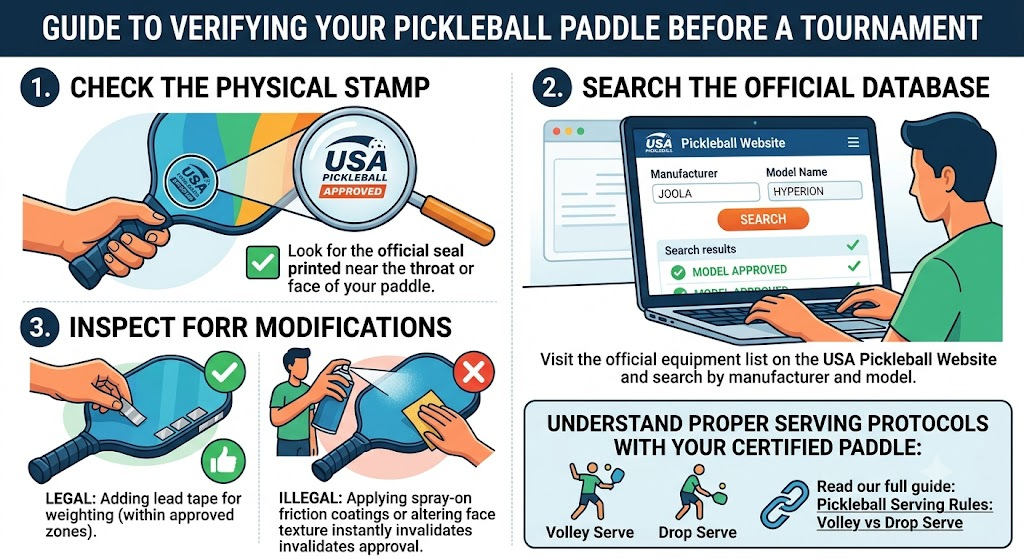
- Find the stamp. Approved paddles carry a USA Pickleball approval seal, usually printed near the throat or on the face. Its absence is not automatically disqualifying, but its presence saves an argument.
- Search the official database. Look up your paddle by manufacturer and model on the USA Pickleball approved equipment list. Match the exact model name, including the generation or year, because manufacturers reuse names across revisions.
- Check what you have added to it. Edge guard tape, weighted lead tape, manufacturer weight systems, grip inserts, grip wraps and manufacturer replacement faces are all permitted. Anything that alters the playing surface itself is not. A spray-on friction coating or a sanded face voids approval instantly, and it is the modification tournament officials look for first.
- Assess its age honestly. If your paddle is a thermoformed model with heavy use behind it, listen for the hollow note and feel for soft spots. A paddle that has delaminated is not legal, whatever the database says.
Frequently Asked Questions
Do I need an approved paddle for recreational play?
No. The approved equipment requirement applies to USA Pickleball sanctioned tournaments, leagues and qualifiers. Open play at your local courts has no equipment restriction, though club and league organisers sometimes set their own rules.
Is a 16mm paddle legal?
Yes, and so is a 14mm paddle. There is no thickness restriction in the equipment standards. Thickness affects feel, dwell time and power, not legality.
My paddle was approved when I bought it. Is it still legal?
Not necessarily. The PBCoR ceiling dropped to 0.43 on 1 November 2025, and some paddles that were legal before that date no longer are. Physical wear matters too — a delaminated paddle can fail an on-site test even when its model remains listed.
Can I add lead tape to my paddle?
Yes. Weighted tape and manufacturer weight systems are explicitly permitted. What is not permitted is altering the playing surface, which includes coatings, sanding and texturing.
Does a cheap paddle count as approved?
If the model appears on the approved list, yes, and it is exactly as eligible as a premium paddle. Certification is a pass or fail test, not a ranking.
Final Thoughts
Certification is a floor, not a recommendation. It guarantees your paddle is legal to compete with; it says nothing about whether the paddle suits how you play. Once you have confirmed a model is approved, the more useful question is what kind of player you are — someone who ends points early, or someone who outlasts opponents in the soft game — and buy accordingly.
Check the official USA Pickleball approved equipment list before every sanctioned event, especially if your paddle predates the November 2025 PBCoR change or has a season of hard hitting behind it. Two minutes of checking is cheaper than a disqualification.
Standards cited in this guide come from the USA Pickleball Equipment Standards Manual and reflect the rules in force as of August 2026. Equipment rules change; verify against the official list before you compete.

Pingback: Best CRBN Pickleball Paddles: 4 Models Compared (2026)