


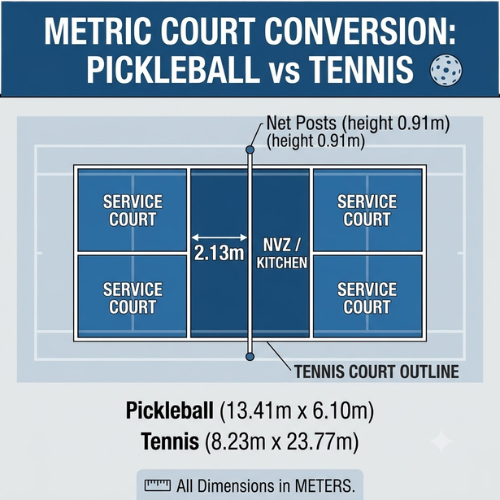
Constructing your own playing space or converting an existing tennis court is one of the fastest ways to enjoy pickleball whenever you want. However, laying down inaccurate boundary lines or miscalculating net height can instantly ruin game mechanics and lead to illegal playing conditions.
Understanding official pickleball court dimensions in both Imperial (feet/inches) and Metric (meters) units is essential for accurate setup.
Whether you are marking a temporary court in your driveway, setting up a community space, or converting a tennis court, this guide delivers a comprehensive metric blueprint alongside the essential gear needed for a professional finish. Before laying your lines, make sure you understand basic court positioning rules by reviewing Standard Pickleball Doubles Rules and Court Positioning for Beginners.
Key Takeaways: Official Court Specifications
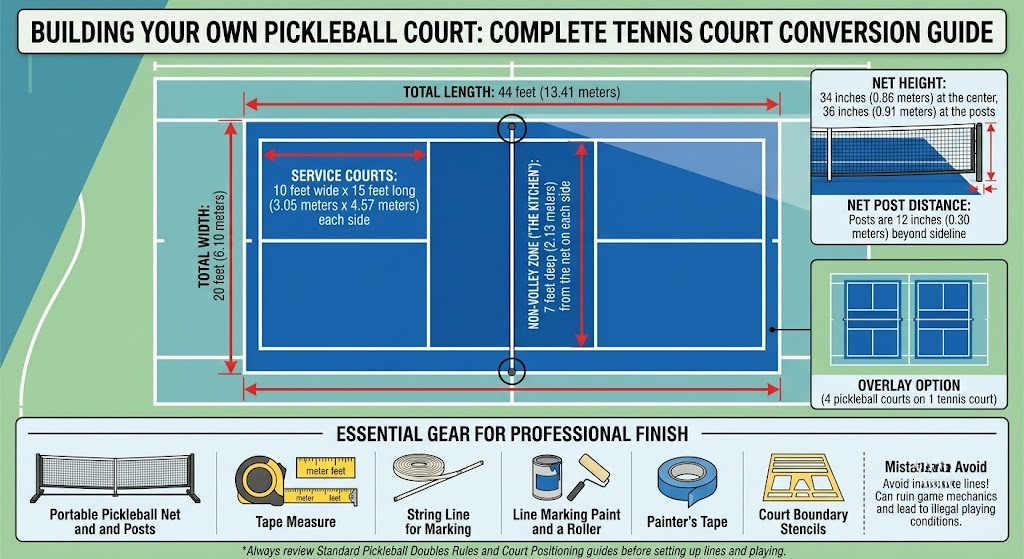
- Total Playing Surface: 20 feet wide by 44 feet long (6.10 m x 13.41 m).
- Non-Volley Zone (Kitchen): Extends 7 feet (2.13 m) back from the net on both sides.
- Net Dimensions: 36 inches (0.91 m) high at the sidelines, tapering to 34 inches (0.86 m) at the center strap.
- Recommended Overall Footprint: 30 feet wide by 60 feet long (9.14 m x 18.29 m) to allow safe out-of-bounds overrun space.

Official Pickleball Court Size: Imperial vs. Metric Specifications
Official regulations specified by USA Pickleball state that pickleball court size remains identical for both singles and doubles play. The court layout is symmetrical, divided equally by a center net.
Below is the complete metric and imperial measurement breakdown required to line a regulation court correctly:
| Court Feature | Imperial Measurement (Feet/Inches) | Metric Measurement (Meters) |
|---|---|---|
| Total Court Length | 44 feet 0 inches | 13.41 meters |
| Total Court Width | 20 feet 0 inches | 6.10 meters |
| Non-Volley Zone (Kitchen) | 7 feet 0 inches (from net) | 2.13 meters |
| Service Court Width | 10 feet 0 inches | 3.05 meters |
| Service Court Length | 15 feet 0 inches | 4.57 meters |
| Net Height at Sidelines | 36 inches | 0.91 meters |
| Net Height at Center | 34 inches | 0.86 meters |
| Min. Total Playing Area | 30 feet × 60 feet | 9.14 meters × 18.29 meters |
For a detailed breakdown of how boundary lines interact with non-volley zone penalties during play, read our deep-dive on Pickleball Kitchen Rules: Eradicate Foot Faults.
Tennis Court vs. Pickleball Court Size Breakdown
A standard tennis court playing area measures 36 feet wide by 78 feet long, with an overall pad size of approximately 60 feet by 120 feet. Because a standard pickleball court size ($20\text{ ft} \times 44\text{ ft}$) is significantly smaller than a tennis court, tennis facilities offer the ultimate conversion pad.
| TENNIS COURT PAD | ||
|---|---|---|
| Pickleball Court 1 (20′ x 44′) |
TENNIS NET | Pickleball Court 2 (20′ x 44′) |
| Pickleball Court 3 (20′ x 44′) |
Pickleball Court 4 (20′ x 44′) |
|
Conversion Capacities:
- 1 Tennis Court = 1 Temporary Pickleball Court: Simply use the existing tennis net center and tape down pickleball sidelines and kitchen boundaries.
- 1 Tennis Court = Up to 4 Regulation Pickleball Courts: By removing the permanent tennis net or working around it, you can fit four distinct 20×44 ft pickleball courts on a single standard tennis surface pad.
Step-by-Step Blueprint: Converting a Tennis Court to Pickleball
Converting an asphalt or acrylic tennis court into a dedicated pickleball space requires three steps: measuring, taping, and net installation.
Step 1: Measure and Chalk the Boundaries
Using a long measuring tape, locate the center point of your playing surface. Measure out a rectangle 44 feet (13.41 m) long by 20 feet (6.10 m) wide. Snap chalk lines to establish your baseline, sidelines, non-volley zone (7 ft from center), and center line.

Step 2: Apply Specialized Court Line Tape
Do not use standard masking tape or duct tape; they leave adhesive residue, tear under foot traction, or peel off when wet. Use high-durability, weather-resistant court marking tape designed specifically for acrylic surfaces.
Equipment Recommendation: Heavy-Duty Court Line Tape When marking lines on concrete or asphalt, standard tape wears down quickly. Use commercial-grade, non-glare court line tape that resists lateral foot-scuffs and withstands outdoor weather without damaging court paint.
Looking to lay down clean, weather-proof boundary lines on your local court?

Explore Commercial-Grade Court Marking Tape at qtpickleballstore.com
Step 3: Install a Regulation Portable Net System
Permanent net posts require concrete footings and high installation costs. A heavy-duty portable pickleball net system provides the perfect solution for tennis court conversions. USAPA-compliant portable nets feature steel frames, tension straps, and center support posts to guarantee an exact 34-inch center net height.
Gear Spotlight: USAPA-Approved Portable Net Systems Never play with sagging nets. High-grade portable systems assemble in under 5 minutes, utilize powder-coated steel bases for wind stability, and feature adjustable center tension straps to maintain precise regulatory net height.
Shop Tournament-Ready Portable Net Systems & Carrying Sets
Essential Equipment Checklist for DIY Court Conversions
To ensure your temporary or permanent setup meets competitive standards, gather these tools before beginning your conversion project:
- Measuring Tape (100 ft / 30m): For establishing precise 20×44 ft perimeter dimensions.
- Chalk Line Box: For snapping temporary guidelines before applying permanent line tape.
- Heavy-Duty Court Tape: 2-inch wide, high-contrast tape (yellow or white works best on dark tennis courts).
- Portable Net System: Steel-frame net equipped with a center height tension strap.
- Laser Measure or Height Gauge: To verify the 36-inch sideline height and 34-inch center drop.
Review legal serving heights over your new portable net setup in our guide to Pickleball Serving Rules: Volley Serve vs. Drop Serve.
Common Layout Mistakes to Avoid
When measuring official pickleball court dimensions, minor calculations errors can disrupt your gameplay:
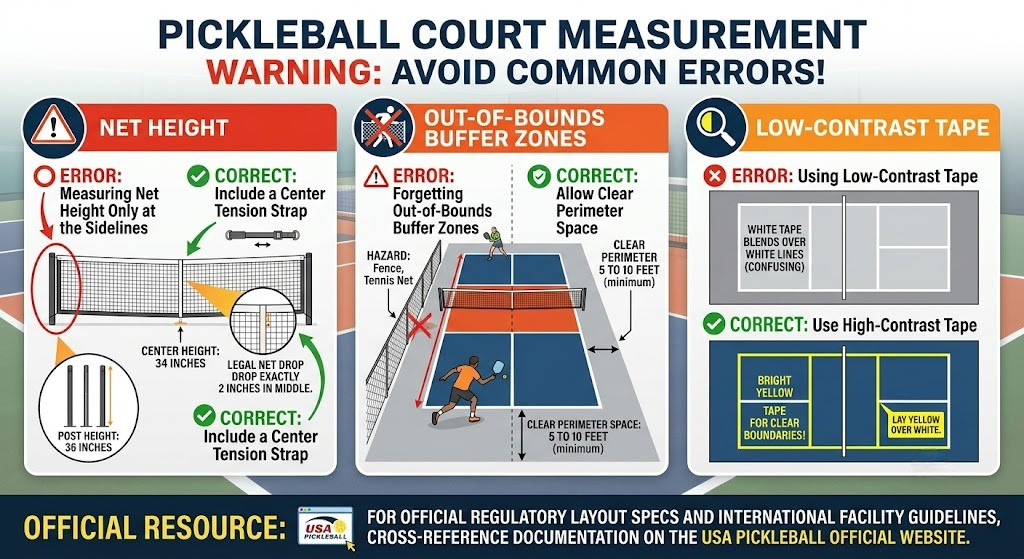
- Measuring Net Height Only at the Sidelines: Remember that a legal net must drop exactly 2 inches in the middle ($36\text{ inches}$ at posts, $34\text{ inches}$ at center). Always use a center tension strap.
- Forgetting Out-of-Bounds Buffer Zones: Placing sidelines too close to fences or tennis nets creates safety hazards during high-speed baseline chases. Leave at least 5 to 10 feet of clear perimeter space.
- Using Low-Contrast Tape: White tape can blend into existing tennis lines. Use bright yellow tape when laying pickleball boundaries over existing white tennis lines.
For official regulatory layout specs and international facility guidelines, cross-reference documentation on the USA Pickleball Official Website.
Final Thoughts: Build Your Dream Court Today
Understanding official pickleball court dimensions gives you the blueprint needed to transform any flat asphalt or tennis surface into a professional-grade arena. With the right court marking tape and a tournament-standard portable net system, you can set up a high-quality court anywhere in minutes.
Gear up for your court conversion with premium portable nets, court marking accessories, carbon fiber paddles, and outdoor balls at qtpickleballstore.com!
