


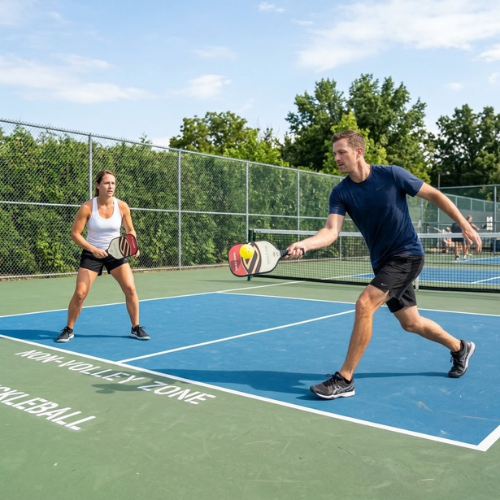
Ask any intermediate pickleball player where their rallies go to die, and they will almost always point to the transition zone. Rushing from the baseline to the non-volley zone line while facing an opponent who is already established at the net is the single most demanding physical and mental challenge in the sport. If your drops are too high, you get smashed; if your drives are too passive, you get blocked out of the point.
To bridge this structural gap and develop bulletproof muscle memory, you need targeted, situational pickleball training.
Enter the 7 11 pickleball drill.
This highly competitive, asymmetric training game isolates the exact pressure cooker scenario of a mid-court transition. By practicing this drill regularly, you learn how to balance aggressive baseline drives with feather-light drop shots under simulated match pressure. Before you step out to set up this drill, make sure you are fully aligned with the baseline foundational regulations of the sport by referencing our comprehensive guide: The Official Rules of Pickleball: Ultimate Beginner to Pro Guide.

Understanding the 7 11 Pickleball Rules and Setup
The beauty of the 7 11 pickleball drill lies in its structural imbalance. Unlike a standard practice session where both players drop back or stay up, this drill assigns completely different scoring parameters and positional goals to each athlete.
7-11 Drill Court Positioning
Visual breakdown of the asymmetric battleground
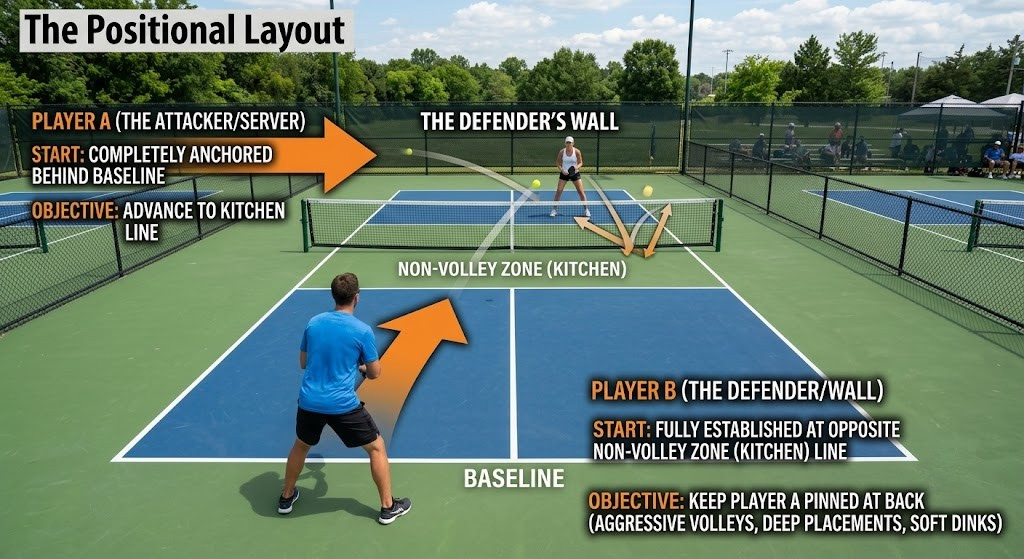
The Positional Layout
- Player A (The Attacker/Server): Starts completely anchored behind the baseline. Their primary objective is to hit precise shots that allow them to physically advance to the Kitchen line.
- Player B (The Defender/Wall): Starts fully established at the opposite Non-Volley Zone (Kitchen) line. Their objective is to use aggressive volleys, deep placements, and soft dinks to keep Player A pinned at the back of the court.
The Asymmetric 7 11 Pickleball Rules
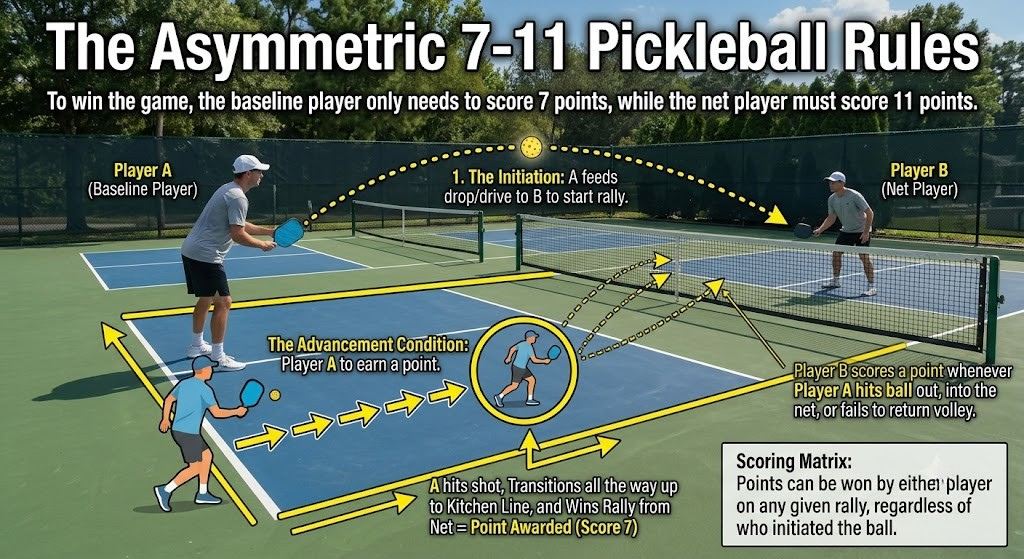
To win the game, the baseline player only needs to score 7 points, while the net player must score 11 points.
- The Initiation: Player A (baseline) feeds a drop or drive to Player B (net) to start the live rally.
- Live Play Boundaries: The rally is played straight-ahead down the line (half-court) to maximize control and keep repetitions high.
- Scoring Matrix: Points can be won by either player on any given rally, regardless of who initiated the ball.
- The Advancement Condition: Player A can only earn a point if they successfully hit a shot, transition all the way up to their own Kitchen line, and win the rally from the net. If Player A wins a rally while still trapped at the baseline or inside no-man's-land, no point is awarded, and the rally simply resets. Player B scores a point whenever Player A hits the ball out, into the net, or fails to return a volley.
Step-by-Step Execution: How to Run the Drill
To get the absolute most out of every training session, do not just mindlessly slap the ball back and forth. Run the 7 11 pickleball drill with deliberate tactical intent by following this structural phase guide:
Phase 1: The Baseline Attack
Player A drops the ball and hits either a heavy topspin drive or a calculated drop shot. As the baseline player, your goal here is not necessarily to hit an outright winner, but to force Player B into an uncomfortable contact point.

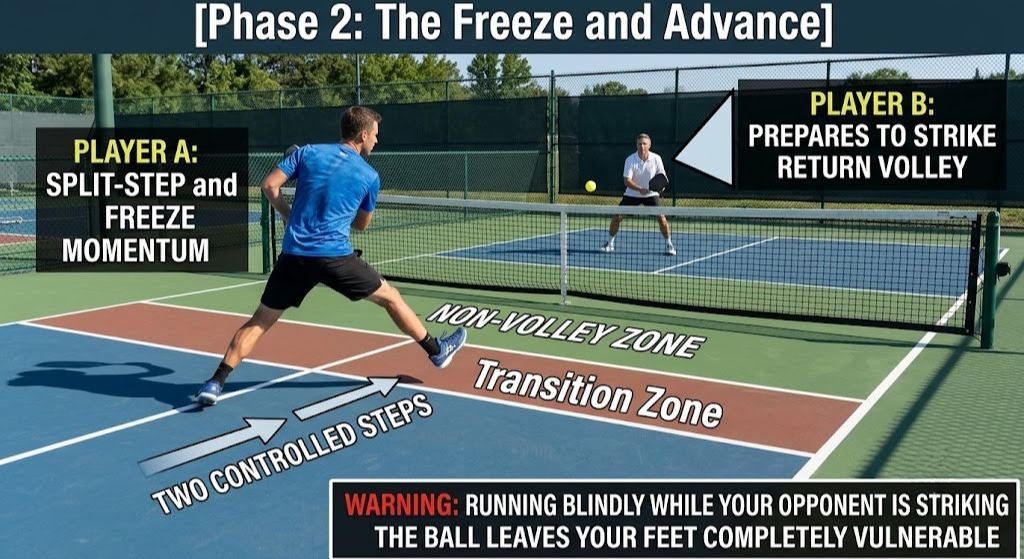
Phase 2: The Freeze and Advance
If Player A hits a deep, unattackable ball, they take two controlled steps forward into the transition zone. However, the moment Player B prepares to strike the return volley, Player A must split-step and freeze their forward momentum. Running blindly while your opponent is striking the ball leaves your feet completely vulnerable.
Phase 3: The Short-Hop Reset
Standing in the mid-court, Player A must cushion the opponent's aggressive volley into the kitchen. Once a successful reset lands softly over the net, Player A sprints the final few feet to lock down their position at the Kitchen line, turning the drill into a traditional dink battle until the point concludes.
If you find yourself consistently struggling to drop the ball softly from no-man's-land during these sequences, master the mechanical touch required by checking out our technical guide: 3rd Shot Drop Masterclass: 7 Simple Steps to Ultimate Control.

The Gear Factor: Why Ball Consistency Dictates Your Training Success
You can have flawless footwork and perfect paddle scaling, but if you are running the 7 11 pickleball drill with worn-out, warped, or erratic practice balls, your training progression will hit a wall.
Mid-court transitions rely entirely on micro-adjustments and predictable ball physics. If a ball lacks a perfectly round shape or possesses uneven hole distribution, its bounce on grittier concrete court surfaces will be completely unpredictable. This forces you to adjust to bad data, ruining the exact muscle memory you are trying to build.
[Premium Training Ball]  ---> Predictable Compression ---> Consistent True Bounce ---> Perfect Muscle Memory
[Warped/Cheap Ball]      ---> Erratic Flight Path     ---> Dead/Skidding Bounces ---> Ruined Transition Timing
For rigorous drilling sessions where you are hitting hundreds of balls per hour, you must equip your hopper with professional-grade, highly durable pickleball balls that maintain their roundness under violent paddle impacts. True training balls feature precision-molded seam designs that ensure a uniform bounce, giving you the clean feedback needed to master your touch.
Don't let bad equipment ruin your drilling rhythm. Stock your training bag with our collection of tournament-grade, highly consistent Pickleball Balls engineered to deliver an unyielding, true bounce on any outdoor or indoor surface.
Key Tactical Takeaways for Court Domination
Consistently winning as the baseline player in the 7 11 pickleball drill requires you to abandon raw power and embrace chess-like patience. Keep these internal adjustments in mind:
- Vary Your Openings: Don't hit the exact same drive every time. Alternate between a hard drive down the line to test their reaction time, and a soft drop to their backhand to force an immediate reset.
- Respect the Kitchen Boundaries: Remember that even during aggressive drilling exchanges, standard Pickleball Kitchen Rules apply. Stepping on the non-volley zone line during a rushed volley will instantly cost you the point.
- Switch Roles Regularly: Spend 20 minutes as the baseline attacker, then switch to the net defender. Playing at the net against a transitioning player teaches you exactly how to spot the visual cues of a weak drop shot.
By mastering the mechanical flows isolated within this specialized training game, you eradicate the fear of “no-man's-land” and build the physical discipline required to dominate the transition zone in any competitive bracket. Grab a fresh bucket of consistent balls, head out to your local court, and drill your way to ultimate control.
