
To truly enjoy the game, understanding the official pickleball scoring rules is the very first step when you walk onto any vibrant court. While the rhythmic chants echoing from the serving baseline like “0-0-2” might sound confusing at first, deciphering this numeric code is your ultimate ticket to confident play.
To the uninitiated, pickleball scoring sounds less like a sport and more like a secret military broadcast.
Unlike tennis, where scores advance through a historic nomenclature of 15, 30, and 40, or ping-pong, which utilizes simple sequential integers, pickleball implements a highly strategic, multi-number tracking system. If you are learning the foundational rules of pickleball, deciphering this code is your ultimate ticket to confident play. Calling the wrong sequence doesn't just invite awkward court corrections from your opponents—it can result in a structural technical fault that costs your team a point or a side-out.
Before diving deep into the mathematical mechanics of the serving rotation, ensure you have a firm grasp of the overall game layout by bookmarking our foundational handbook: The Official Rules of Pickleball: Ultimate Beginner to Pro Guide.

The Golden Rules of Pickleball Scoring
Regardless of whether you are playing a fast-paced solo singles match or a highly tactical doubles game, the game operates under three unyielding laws:
- Serve to Score: You can only score a point when your side is actively serving. If you are on the receiving team and your opponent commits a fault or hits the ball out of bounds, no point is added to the scoreboard; instead, you earn a side-out or force a server rotation.
- The Target Number: A standard game is played to 11 points.
- The Two-Point Margin: You cannot win a match with a narrow score of 11-10. The official pickleball scoring rules require a clear victory margin of two points. Rallies continue dynamically past 11 (e.g., 12-10, 14-12, or even 21-19) until one side establishes that two-point gap.
Decoding Doubles Scoring: The 3-Number Sequence
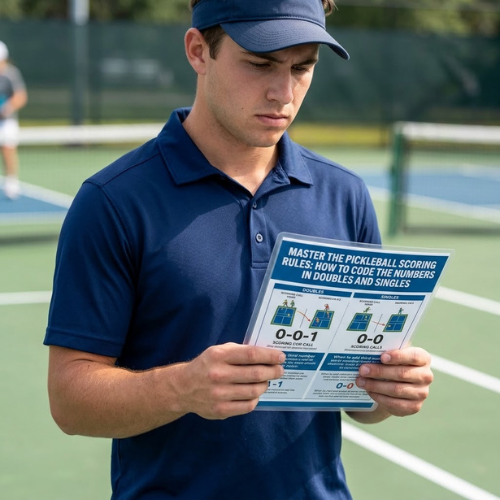
In a standard doubles match, the score is always announced using three distinct numbers. The serving player must call these numbers out loud before making physical contact with the ball. The exact formula is:
The fundamental framework of standard pickleball scoring rules relies on a clear three-digit vocal sequence
To ensure you never get confused during a high-stakes transition game, copy this interactive structural decoder into your memory bank:
| The Doubles Score Decoder | |
|---|---|
| Serving Team Score | 6 |
| Receiving Team Score | 4 |
| Server ID | 2 |
| Explanation | In this scenario, the serving team has 6 points, the receiving team has 4 points, and the second partner on the serving team is currently serving. |
Understanding Server 1 vs. Server 2
At the start of a side-out, the player standing on the right-hand side of the court always becomes Server 1. If the serving team wins a point, Server 1 switches sides with their partner and serves again from the left court. This alternation continues until the serving team loses a rally.
Instead of yielding the ball to the opponents immediately, the serve now shifts to the second partner, who becomes Server 2. They serve from whichever side of the court they are currently standing on. Only after Server 2 loses a rally does a formal “Side-Out” occur, passing the ball over to the opponents.
⚠️ The 0-0-2 Start Exception: To balance the game's opening momentum, the very first serving team of a new match is only allowed one server rotation instead of two. Therefore, the match always begins with the score called out as 0-0-2. Once that initial server loses the rally, a side-out is immediately triggered.
If a team forgets who serves first, they immediately violate the mechanical flow of the pickleball scoring rules

Simplified Singles Scoring: The 2-Number Sequence
If you are shifting gears to individual tournament brackets, singles pickleball scoring drops the complex partner dynamics completely. Because there is no second teammate to track, the score is reduced to a clean, two-number sequence:
Shifting to individual match play alters how you apply the traditional pickleball scoring rules on court
How the Score Controls Your Positioning
In singles play, your current score dictates exactly which side of the baseline you must serve from. The math is beautifully absolute:
- Even Scores (0, 2, 4, 6, 8, 10): The server must stand on the Right side of the court (the Even court).
- Odd Scores (1, 3, 5, 7, 9): The server must stand on the Left side of the court (the Odd court).
The receiver simply aligns themselves diagonally across the net from the server. To adapt your physical stamina and deep drives for this relentless, solo variation of the game, read our master tactical guide: Official Pickleball Rules for Singles: Major Strategy Shifts from Doubles Play.
Common Scoring Mistakes and How to Prevent Them
Many unforced technical faults stem from a simple misunderstanding of the official pickleball scoring rules. Even advanced athletes tracking complex kitchen boundaries can experience a cognitive lapse when calling the score. Watch out for these three frequent infractions:
- Serving Before Calling the Score: You must announce the entire three-digit sequence before your paddle strikes the ball. Initiating your upward arm swing in complete silence can result in a structural rule distraction fault. To master the strict arm parameters required for a legal opener, read our Comprehensive Guide to Pickleball Serving Rules: Volley Serve vs. Drop Serve.
- Getting Trapped in the Wrong Box: If you lose track of whether you are Server 1 or Server 2, you will frequently stand on the wrong side of the court. The Fix: Remember that your team's starting Server 1 will always be in the right-hand court whenever your team's score is an even number.
- Forgetting the Two-Bounce Requirement: In the heat of counting points, players often rush the net immediately after a great serve. Don't let scoring excitement ruin your structural positioning. Keep your baseline transitions secure by tracking The Pickleball 2-Bounce Rule Explained: Master the Strategic Transition Zone.
Elevate Your Tournament Game: Essential Scoring Accessories
Understanding the official pickleball scoring rules gives you a massive mental edge, but mid-game disputes can completely destroy your competitive focus. There is nothing worse than executing a flawless third-shot drop, only to get dragged into a five-minute argument with your opponents about whether the score is 6-4-2 or 5-5-1.
To protect your focus and maintain absolute operational authority on the court, explore these professional-grade performance accessories available at qtpickleballstore.com:
- Portable Mechanical Scorekeepers: Eliminate the guesswork entirely. We stock ultra-lightweight, weather-resistant score tracking clips that attach directly to the throat of your paddle or clip onto the net line, allowing you to update the digits manually after every rally.
- High-Absorbency Compression Wristbands: In intense singles matches where you are constantly moving, sweat can impair your vision and loosen your grip. Our premium, extra-wide tournament wristbands keep your hands dry while acting as a physical reminder of your baseline serving cycles.
- USA Pickleball Certified Training Hoppers: If you are running repetitive scoring simulation drills like the famous 7-11 Pickleball Drill, you need a constant supply of consistent balls. Invest in heavy-duty portable travel caddies built to hold 60+ tournament-grade balls effortlessly.

Final Thoughts on Rule Mastery
Mastering pickleball scoring transitions you from a casual backyard enthusiast into a disciplined, respected competitor. By understanding the three-number code, executing proper side rotations based on even/odd metrics, and utilizing professional accessories to prevent court arguments, you keep your mental clarity focused exactly where it belongs: dominating the tactical flow of the rally.
Study the numbers, announce your code with confidence, and back your tournament play with premium, high-performance accessories from qtpickleballstore.com.
