

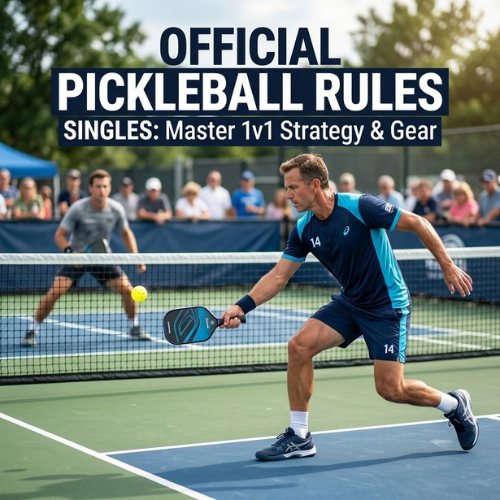
Stepping onto the court for a solo duel is an exhilarating shift from standard doubles play. In a singles match, there is no partner to cover your backhand, no second server to bail you out after an error, and zero room for sluggish footwork. Mastering the official pickleball rules singles setup requires a complete recalibration of your court geometry, serve rotation mental model, and physical conditioning.
While the court dimensions remain identical to doubles (20 feet wide by 44 feet long), covering that entire expanse alone transforms the dynamic of the game completely.
Whether you are transitioning from traditional tennis or looking to test your endurance in local tournament brackets, understanding the distinct operational framework of 1v1 pickleball is the first step toward baseline dominance. Before diving into solo court positioning, ensure you have a firm grasp of the overall baseline rulebook by bookmarking our foundational guide: The Official Rules of Pickleball: Ultimate Beginner to Pro Guide.

Core Mechanics: How Singles Pickleball Differs from Doubles
While the fundamental rules—such as the non-volley zone (Kitchen) restrictions and non-volley kitchen line rules—apply universally, 1v1 pickleball eliminates partner rotation mechanics entirely.
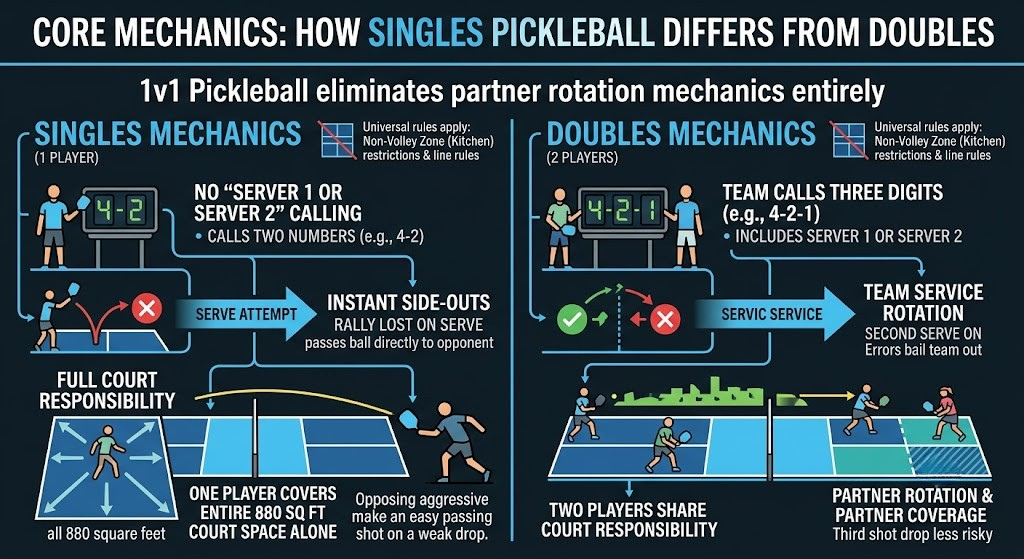
Here is what changes when you step onto the court alone:
- No “Server 1 or Server 2” Calling: In doubles, you call three digits (e.g., 4-2-1). In singles, you only call two numbers: Server Score – Receiver Score (e.g., 4-2).
- Instant Side-Outs: Because there is no second server on a team, losing a rally on your serve results in an immediate side-out, passing the ball directly to your opponent.
- Full Court Responsibility: You must cover all 880 square feet of court space alone. A weak third-shot drop that would be safe in doubles becomes an easy passing shot winner for an aggressive singles opponent.
The Even/Odd Serving Rule in 1v1 Pickleball
In singles, your current score dictates exactly where you stand to initiate every rally. Memorizing this relationship is essential to avoid serving position technical faults under official pickleball rules singles standards.
The Math of Positioning
- Even Score (0, 2, 4, 6, 8, 10…): The server must serve from the Right Court (the Even side) diagonally to the receiver's right court.
- Odd Score (1, 3, 5, 7, 9…): The server must serve from the Left Court (the Odd side) diagonally to the receiver's left court
- The receiver automatically aligns diagonally across the net based on where the server is standing. For a deep dive into legal serving techniques and arm angles, consult our Comprehensive Guide to Pickleball Serving Rules: Volley Serve vs. Drop Serve.
1v1 Singles Rules
Serving Position Decoder
Determine your serving court based on your current score
Even Score
Serve From
Odd Score
Serve From
Tactical Shifts: How to Win Matches in 1v1 Pickleball
Applying singles pickleball rules effectively requires a completely different tactical strategy compared to doubles:
1. The Power Drive Over the Soft Drop
In doubles, hitting a soft 3rd shot drop into the kitchen is standard protocol. In 1v1 pickleball, however, soft drops can leave too much open court space for your opponent to run down. Singles players rely heavily on aggressive, heavy-topspin baseline drives to force weak returns before advancing to the net.

2. Deep Baseline Serving
Because you have no partner to cover the sideline passing lanes, serving deep to the corners forces your opponent behind their baseline. This extra distance gives you time to recover toward the center T-position of your court.
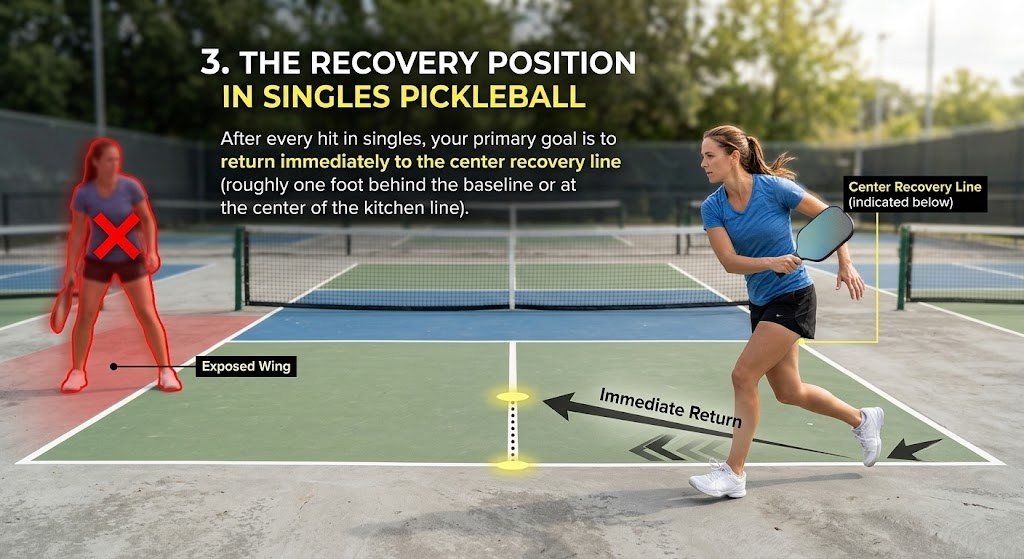
3. The Recovery Position
After every hit in singles, your primary goal is to return immediately to the center recovery line (roughly one foot behind the baseline or at the center of the kitchen line). Leaving one wing completely exposed is the most common tactical mistake beginners make.
Equipment Advantage: Why Elongated Paddles Dominate Singles Play
Because court coverage is the single greatest physical challenge when executing pickleball rules singles strategies, your equipment selection can make or break your performance.
Standard wide-body paddles (16 inches long by 8 inches wide) offer a generous sweet spot, but they lack the physical reach needed to chase down wide passing shots or hit deep baseline drives.
This is why elite tournament players almost universally switch to Elongated Paddles for singles play.
Equipment Comparison
Paddle Shape & Performance Impact
How paddle dimensions affect your court coverage and playstyle
Shape 01
Standard Wide-Body Paddle
Max Sweet Spot Width
Short Reach
Passing Shots
Shape 02
Elongated Paddle (16.5″)
Maximum Reach
Higher Swing Power
Total Court Coverage
Key Advantages of Elongated Paddles in 1v1 Play:
- Extended Physical Reach (16.5″ Max Length): The extra half-inch to inch of length acts as an extension of your arm, allowing you to scrape wide passing shots off the court that would otherwise be out of reach.
- Increased Leverage & Pop: The elongated shape shifts the paddle's balance slightly higher up the face. This creates greater tip speed during your swing, generating explosive power on baseline drives and overhead smashes.
- Superior Counter-Attacks at the Net: When both players lock into a fast-paced singles kitchen battle, an elongated paddle allows you to intercept balls out of the air earlier, cutting off your opponent's recovery angles.
Looking to upgrade your singles gear? Explore our hand-picked collection of high-performance Elongated Carbon Fiber Paddles engineered specifically for maximum reach, power, and spin generation.

Common Singles Infractions & How to Prevent Them
Even seasoned players accustomed to competitive regulations commit unforced errors when playing solo matches. Avoid these common violations:
- Wrong-Side Serving: Always double-check your score before serving. Serving from the right court when your score is 3 (an odd number) results in an immediate fault if called before the next serve.
- Forgetting the Two-Bounce Rule: You must still allow the serve to bounce once on the receiver's side, and the return of serve to bounce once on the server's side, before initiating volleys. Refresh your understanding of this transition zone rule with The Pickleball 2-Bounce Rule Explained.
- Baseline Foot Faults: Stepping on the baseline before striking your serve is frequently called in competitive singles matches.
For official regulatory documentation and international tournament guidelines, you can cross-reference the official handbook on the USA Pickleball Official Website.
Final Thoughts: Master the Solo Game
Mastering the official pickleball rules singles framework demands physical stamina, sharp mental accounting of your even/odd scores, and smart court positioning. By mastering your serve rotations, recovering to the center line after every hit, and leveraging an elongated paddle for maximum reach, you transform the open court into your ultimate competitive advantage.
Gear up with tournament-approved elongated paddles and premium court gear at qtpickleballstore.com to dominate your next 1v1 match!
