


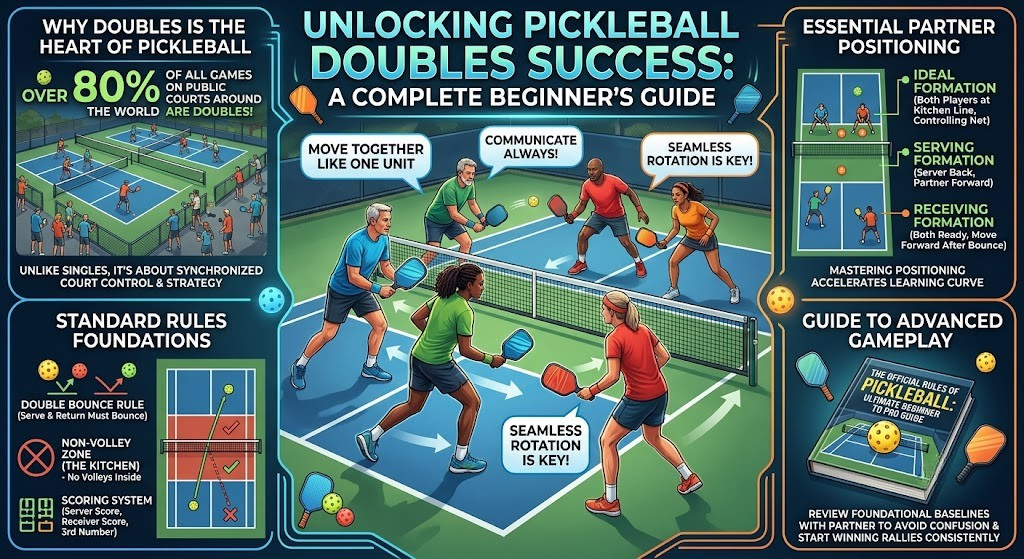
Doubles play is the heart and soul of the sport, accounting for over 80% of all games played on public courts around the world. Understanding the standard pickleball doubles rules and basic partner positioning is essential if you want to avoid confusion on the court and start winning rallies consistently.
Unlike singles play where pure physical coverage dominates, doubles is a game of synchronized court control, strategic communication, and seamless rotation.
Whether you are stepping onto the court for your very first open-play session or teaming up with a friend for local recreational games, mastering the mechanical framework of pickleball rules doubles play will accelerate your learning curve. Before stepping onto the court with your partner, make sure you have reviewed our foundational baseline guide: The Official Rules of Pickleball: Ultimate Beginner to Pro Guide.
The 3-Digit Scoring System and Serving Rotation
The single biggest hurdle for beginner doubles players is understanding how the serving rotation flows between four players. Official pickleball doubles rules dictate that teams call out a 3-digit score before every single serve:
For example, calling “4 – 2 – 1” means your team has 4 points, your opponents have 2 points, and you are currently acting as Server 1.
Doubles Serving Rotation Decoder
Server 1 Role
Starts serving from the RIGHT court whenever your team earns a side-out. Keeps serving until your team loses a rally.
Server 2 Role
Takes over serving from wherever they are standing when Server 1 loses a rally. Losing Server 2's rally triggers a Side-Out.
The “First Serve of the Game” Exception
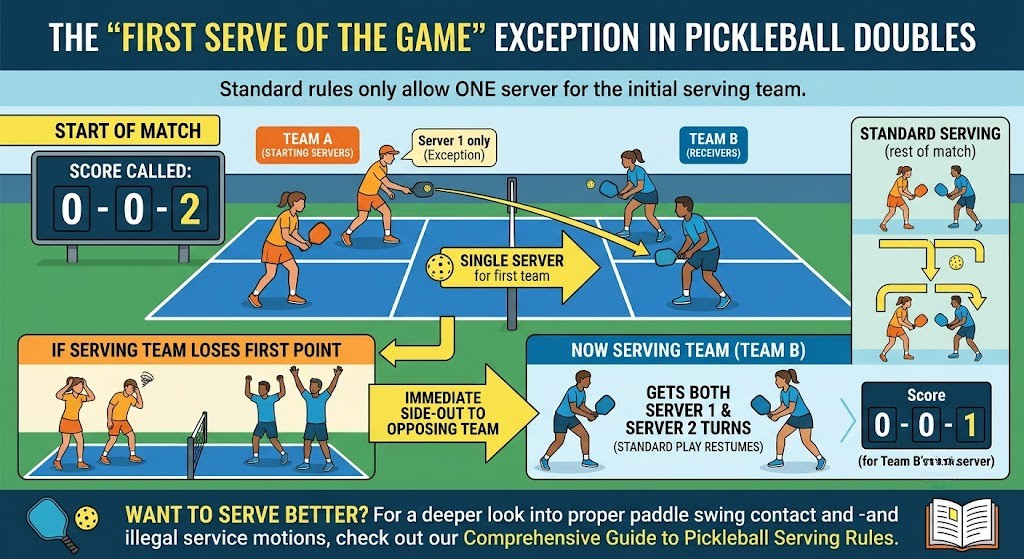
To prevent the starting serving team from gaining an unfair early advantage, standard pickleball doubles rules include one unique exception: The team that serves first at the beginning of a match only gets ONE server.
- At the start of the match, the score is called 0 – 0 – 2.
- If the serving team loses the first point, it immediately side-outs to the opposing team, who then gets both Server 1 and Server 2 turns.
For a deeper look into proper paddle swing contact and illegal service motions, check out our Comprehensive Guide to Pickleball Serving Rules.
Synchronized Court Movement: The “Tethered on a Rope” Principle
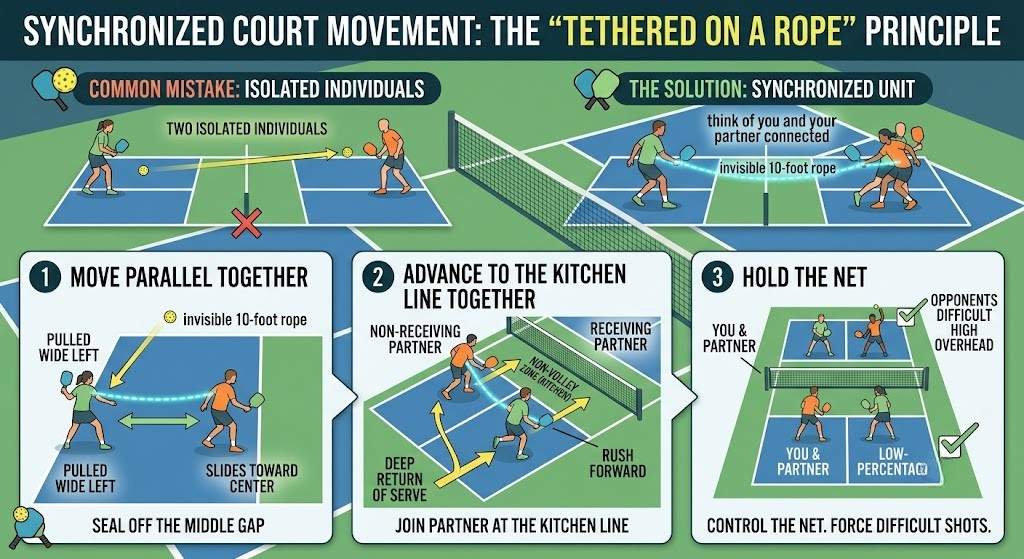
One of the most common mistakes new players make when learning pickleball rules doubles mechanics is playing as two isolated individuals rather than a synchronized unit.
To control open space and prevent passing shots, think of you and your partner as being connected by an invisible 10-foot rope:
- Move Parallel Together: When your partner is pulled wide to the left sideline to return a ball, you must slide toward the center line to seal off the middle gap.
- Advance to the Kitchen Line Together: The non-receiving partner should start near the Non-Volley Zone (Kitchen) line. As soon as the receiving partner hits a deep return of serve, they must rush forward to join their partner at the kitchen line.
- Hold the Net: Winning in doubles requires controlling the kitchen line. Standing side-by-side at the kitchen line blocks your opponents' attack angles and forces them to make difficult overhead or low-percentage shots.
Best Value for Doubles Partners
Ready to Rule the Court Together?
Save up to 25% with our Premium 2-Paddle Starter Bundles! Includes two USAPA-approved carbon fiber paddles, outdoor balls, and a durable carrying bag.
Eliminating the “Middle Void” & Partner Communication
In standard pickleball doubles rules, the area down the center line (known as “the middle”) is where most unforced errors occur for beginners. When a ball flies down the center line, both players often freeze, assuming their partner will take it—or worse, collide paddles attempting to hit the same ball.
Rules of Thumb for Middle Balls:
- Forehand Takes the Middle: The player whose paddle is on their forehand side covering the center line should take responsibility for middle balls.
- Call “Mine” or “Yours” Early: Clear, loud vocal communication eliminates hesitation before the ball crosses the net.
- Cross-Court Coverage: If one partner is caught in the backcourt, the forward player at the kitchen line must shift slightly to cover the middle gap until their partner recovers.
Understanding how points are earned and tracked during these fast-paced middle exchanges is critical. Learn how to maintain flawless score tracking by reading Master the Pickleball Scoring Rules for Singles and Doubles.

Key Rules Every Doubles Partner Must Remember
To avoid giving away free points during competitive play, always keep these standard regulations top-of-mind:
- The Two-Bounce Rule: The serve must bounce once in the receiver's court, and the return of serve must bounce once in the server's court before anyone can hit a volley out of the air. Master this transition rule with our guide on The Pickleball 2-Bounce Rule Explained.
- Receiving Position Limits: Only the designated receiver (standing diagonally across from the server) may return the serve. If their partner touches or hits the serve, it is an immediate fault and a point for the serving team.
- Non-Volley Zone Restrictions: Neither partner may step on or inside the Kitchen line while hitting a volley out of the air.
Common Mistakes Beginners Make in Doubles
Even when players understand basic pickleball rules doubles theory, execution errors happen frequently during match play:
- Serving Out of Order: Serving when it is your partner's turn (or serving from the wrong side of the court based on your score) results in a technical fault.
- Failing to Rush the Net: Staying near the baseline after returning a serve gives up immediate net control to your opponents.
- Isolating vs 1v1 Format: Unlike solo court coverage where elongated paddles are preferred for maximum sweep reach, doubles players often benefit from standard or hybrid paddles that offer maximum sweet spot control and quick hand speed during fast kitchen exchanges. Compare these strategies with our overview on Official Pickleball Rules for Singles.

For official rule clarifications and full regulatory documentation, consult the official handbook on the USA Pickleball Website.
Final Thoughts: Practice Together, Win Together
Mastering standard pickleball doubles rules comes down to clear score calling, smooth serving rotations, and moving in tandem with your partner. By understanding how to cover the court as a unified team and eliminating middle-court communication lapses, you will instantly boost your win rate in recreational and tournament play alike.
Gearing up with a partner? Grab a high-performance 2-Paddle Pickleball Set at qtpickleballstore.com and hit the court with confidence!
