
Mastering the official pickleball serving rules is the fastest way to immediately gain a tactical advantage on the court and stop giving away free points to your opponents. The serve is the single aspect of a pickleball rally that you control entirely from start to finish. Yet many recreational and intermediate players hit illegal serves without even realizing it.
Whether you prefer a traditional volley serve or the modern drop serve technique, failing to follow USA Pickleball rules will result in an immediate fault.
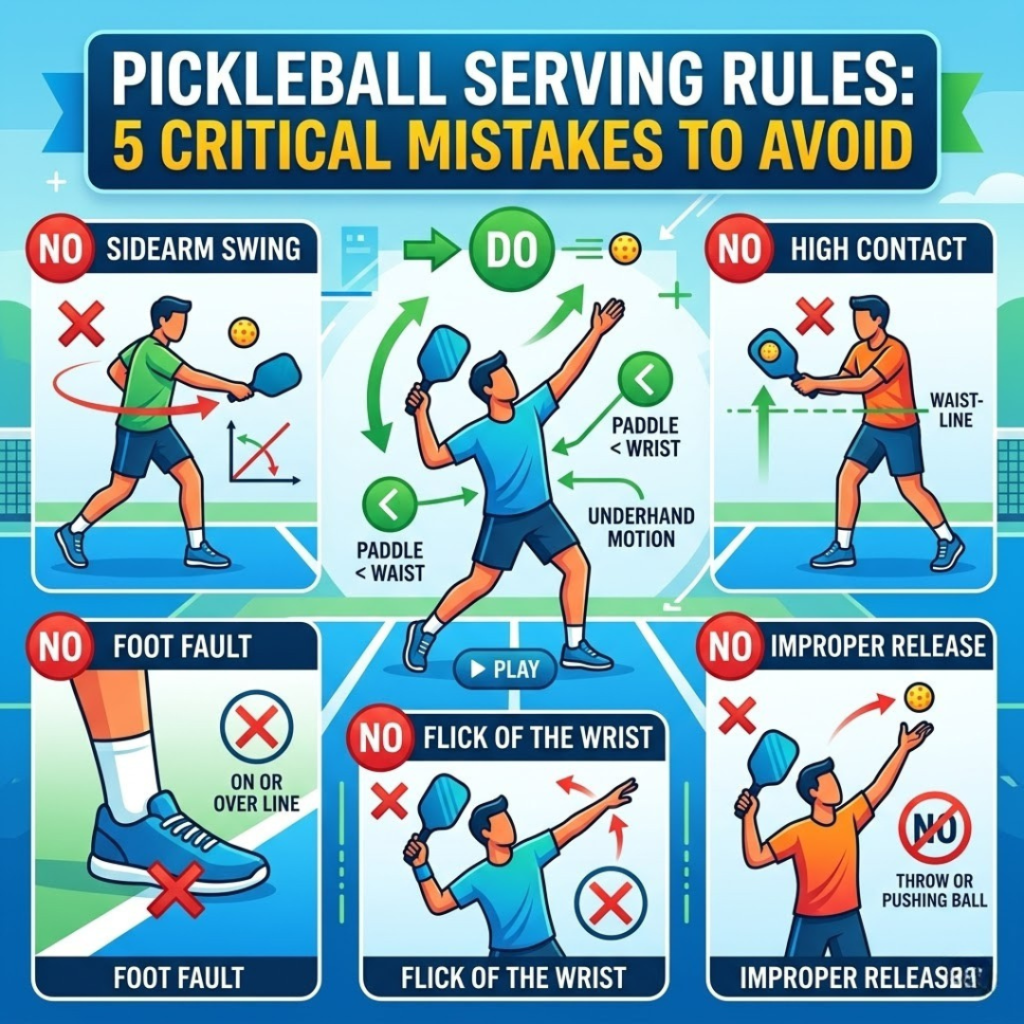
To help you protect your service games, this comprehensive guide breaks down the 5 most critical mistakes to avoid under modern pickleball serving rules, along with actionable fixes to keep your mechanics completely legal.
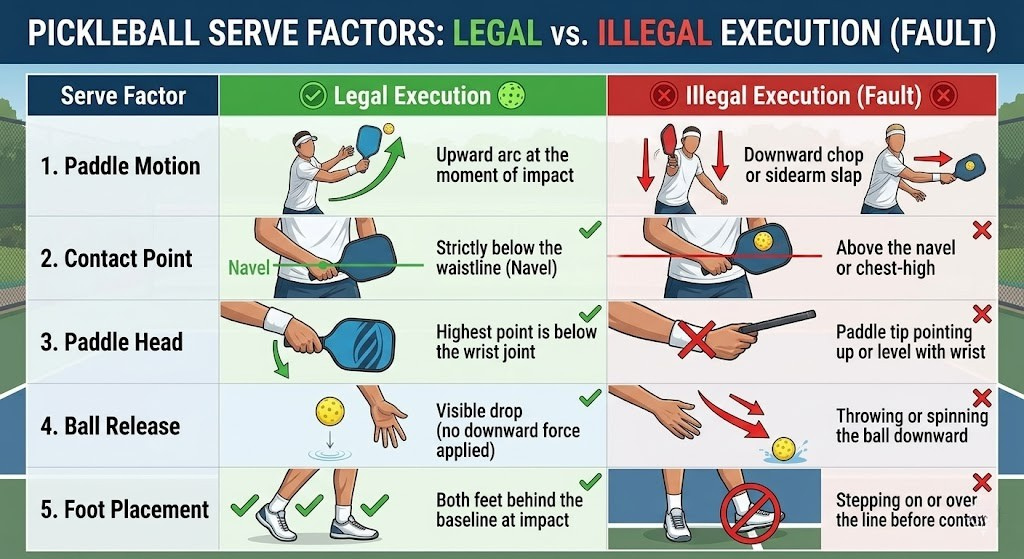
Quick Reference: Legal vs. Illegal Serves
Before diving into the specific errors, let's look at the basic anatomical and structural requirements dictated by the official pickleball serving rules:
| Serve Factor | Legal Execution | Illegal Execution (Fault) |
|---|---|---|
| Paddle Motion | Upward arc at the moment of impact (volley serve) | Downward chop or sidearm slap |
| Contact Point | At or below the navel (volley serve) | Above the navel or chest-high |
| Paddle Head | Highest point clearly below the wrist joint (volley serve) | Paddle tip pointing up or level with wrist |
| Ball Release | Visible drop or release (no downward force, no finger spin) | Throwing or spinning the ball downward |
| Foot Placement | At least one foot grounded behind the baseline; neither foot on the line | Stepping on or over the line before contact |
5 Critical Mistakes under Pickleball Serving Rules
When reviewing the official pickleball serving rules, the most common errors stem from a misunderstanding of paddle geometry and ball-release physics. Avoid these five violations to keep your game clean:
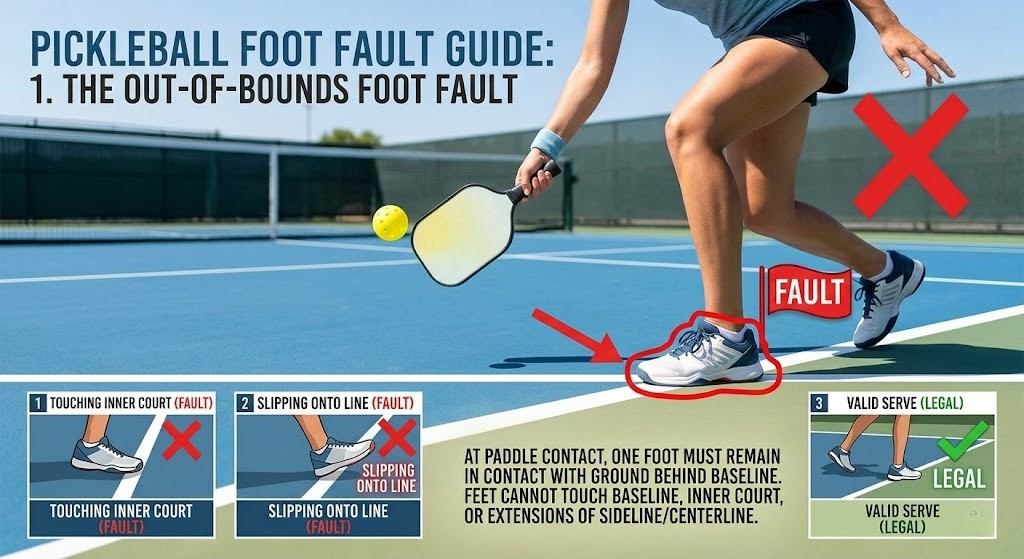
1. The Out-of-Bounds Foot Fault
The first mistake happens before the paddle even touches the ball. According to pickleball serving rules, at the exact millisecond your paddle strikes the ball, at least one foot must remain in contact with the playing surface behind the baseline.
Furthermore, neither of your feet can touch the baseline, the court surface inside the court, or the imaginary extensions of the sideline and centerline. Slipping or sliding your foot onto the white line during your backswing is an automatic foot fault.
2. Striking the Ball Above the Waist
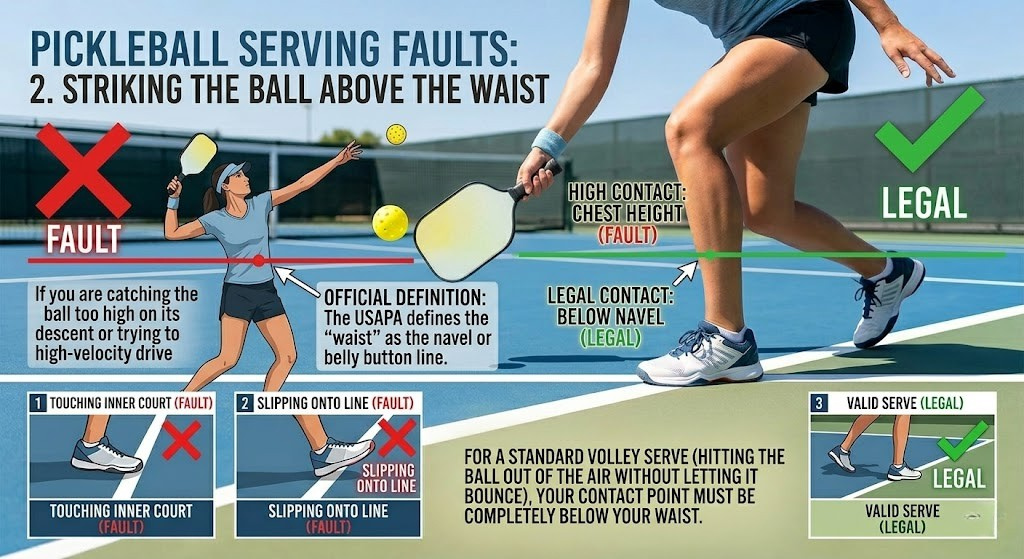
For a standard volley serve (hitting the ball out of the air without letting it bounce), your contact point must be completely below your waist.
Official Definition: USA Pickleball defines the “waist” as the navel or belly button line.
If you are catching the ball too high on its descent or trying to hit a high-velocity drive from chest height, you are committing a major service fault.
3. Executing a Downward or Sidearm Paddle Arc
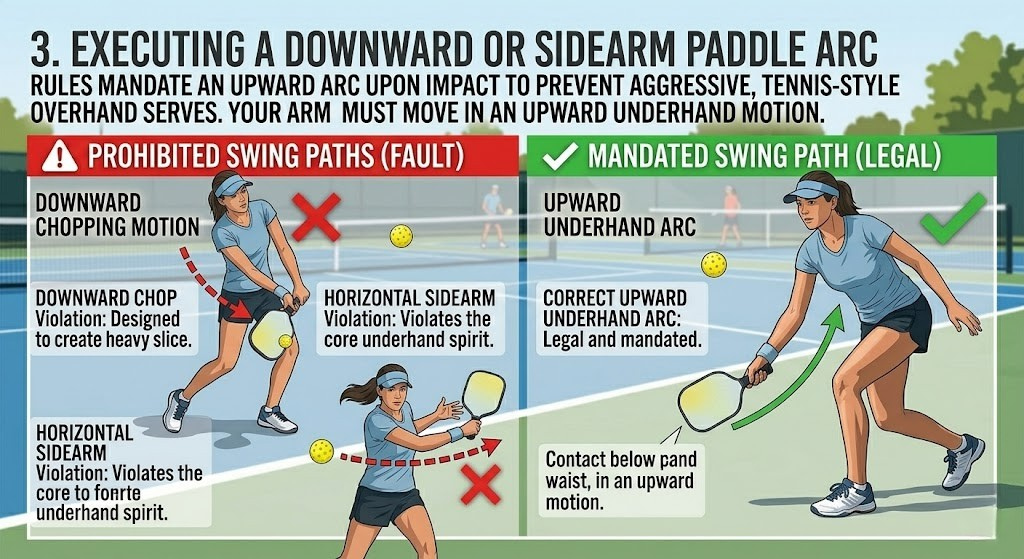
To prevent players from hitting aggressive, tennis-style overhand serves, the rules mandate an upward arc upon impact. Your arm must move in an upward underhand motion. If your swing path looks like a horizontal sidearm slap or a downward chopping motion designed to create heavy slice, it violates the core spirit of the game.
4. Keeping the Paddle Head Above the Wrist
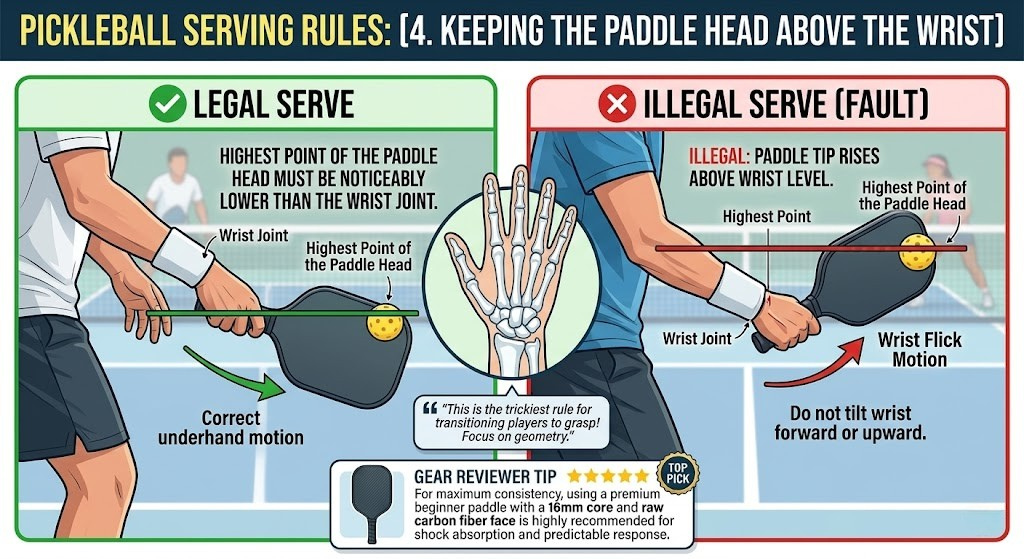
This is the trickiest rule for transitioning tennis or badminton players to grasp. When your paddle contacts the ball, the highest point of the paddle head must be noticeably lower than the highest point of your wrist joint.
If you tilt your wrist forward or upward to “flick” the ball with extra wrist snap, the paddle tip rises above your wrist level, which constitutes an illegal serve.
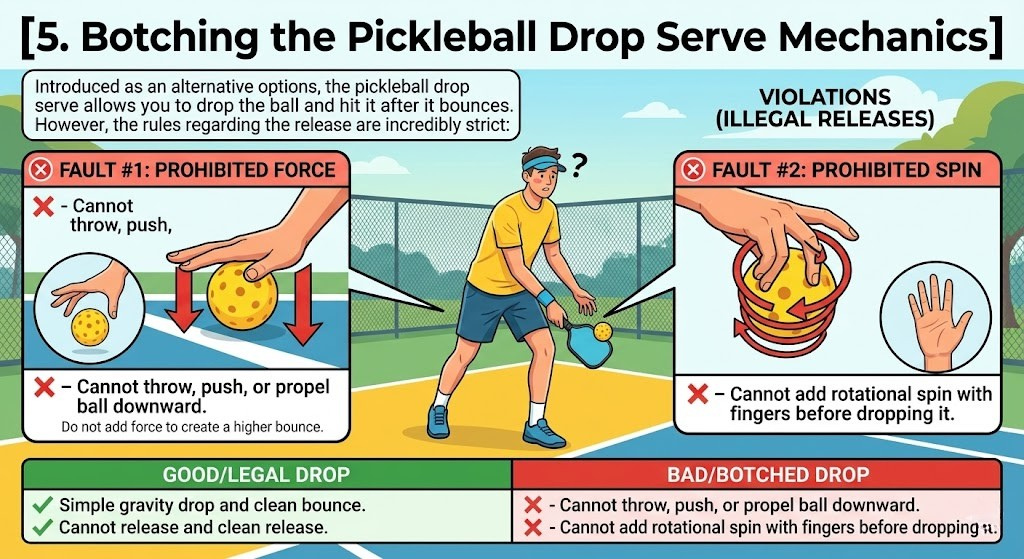
5. Botching the Pickleball Drop Serve Mechanics
Introduced as an alternative to the traditional volley serve, the pickleball drop serve allows you to drop the ball and hit it after it bounces. However, the rules regarding the release are incredibly strict:
- You must release the ball purely from your hand or paddle face.
- You cannot throw, push, or propel the ball downward into the court to create a higher bounce.
- You cannot add any rotational spin to the ball with your fingers before dropping it.
The release is only half the story — what you can do after the bounce is far more flexible. See the full pickleball drop serve rules breakdown below.
Pickleball Drop Serve Rules: What's Legal and What's a Fault
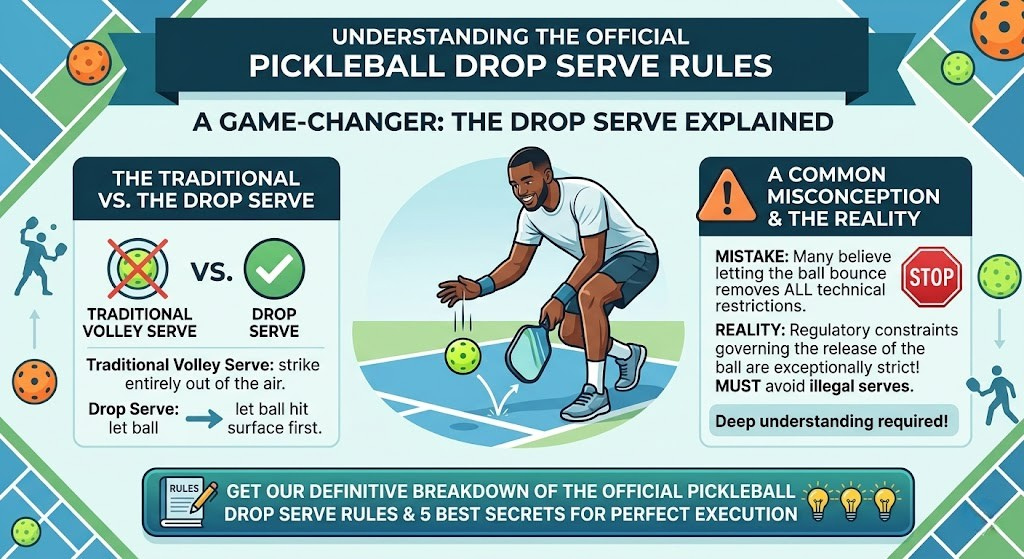
Under the official pickleball serving rules, the drop serve is the simpler of the two legal serves. Instead of striking the ball out of the air, you release it, let it bounce, and then hit it. Because the ball bounces first, the three volley-serve restrictions (contact height, paddle angle, and upward swing path) do not apply — the pickleball drop serve rules focus almost entirely on a clean release.
3 Quick Tips for a Consistent Drop Serve
- Drop from the same height every time. There is no height limit, so pick a release point (around chest height works for most players) that bounces the ball into your strike zone, and repeat it.
- Release with an open palm, or roll it off the paddle face. A clean, open-hand release makes it obvious you did not push or spin the ball.
- Swing as the ball starts to fall. Contacting the ball just after the peak of its bounce is easier to time and helps you keep the serve deep.
Volley Serve vs. Drop Serve: Which Should You Use?
The volley serve gives you a bit more pace and disguise, but it must clearly meet all three requirements — contact at or below the navel, paddle head below the wrist, and an upward arc. Under the current rulebook wording, a borderline volley serve can be called a fault. The drop serve removes those checks entirely, which makes it the safer default for beginners, players coming from tennis, or anyone whose volley serve keeps getting questioned. Plenty of experienced players keep both in their toolkit, since both are fully legal under current pickleball serving rules.
How Your Gear Affects Your Serve Consistency
Maintaining legal mechanics becomes significantly easier when you are playing with high-tier equipment that provides a predictable response off the face.
If you are currently practicing with an unstable, overly rigid paddle, you might find yourself forcing your wrist upward or swinging sidearm just to get the ball over the net. Upgrading to a premium beginner pickleball paddle featuring a 16mm polypropylene honeycomb core and a raw carbon fiber face ensures maximum shock absorption and consistent ball deflection. This stability allows you to focus on a clean, compliant underhand upward sweep every single time.
Final Thoughts on Service Mastery
By memorizing these core pickleball serving rules, you will protect your service turns, project immense confidence on the court, and avoid frustrating arguments during competitive matches. Always check your stance, ensure your arm path sweeps low-to-high, and let your paddle's surface texture do the work.
For a deeper look into court layout requirements and positioning after your serve clears the net, make sure to check out our complete breakdown on Pickleball vs Tennis Court Dimensions. Wondering what happens when a serve clips the net? Our guide to what a let is in pickleball covers the current rule. For the absolute definitive legal text, always consult the official regulatory guide on the USA Pickleball Official Rules website.

Pingback: Let in Pickleball: The Important 2026 Rule Change
Pingback: Pickleball Court Dimensions: Complete Metric Blueprint for Tennis Court Conversions - QT Pickleball Store
Pingback: Master the Pickleball Scoring Rules: How to Code the Numbers in Doubles and Singles - QT Pickleball Store
Pingback: Official Pickleball Rules Singles: Master 1v1 Strategy & Gear - QT Pickleball Store
Pingback: Standard Pickleball Doubles Rules and Court Positioning for Beginners - QT Pickleball Store